Showing posts with label Feldenkrais Method. Show all posts

Monday, January 25, 2010

Order and Chaos -- Again

File CabinetsImage by AirBeagle via Flickr

This weekend, the miraculous manifestation of a used filing cabinet set into motion a chain of events known as "the law of unintended consequences." The Murphy's Law variation is, "Whatever you set out to do, something else must be done first.

Before I knew it, I had turned my office into a total wreck. It seems that things always get a little worse before they get better. My ambition and frustrated longings led me through a train of thought that culminated in the reorganization of my entire office; including (dun dun DUN!!!!) the closet. The simple de-cluttering turned into a "pitch fest." The next step -- loading everything into my car for a trip to recycling.

Two days after beginning, I am finished -- all except for vacuuming in the morning before my first client arrives. I feel ready to welcome new people and new ideas. Possibilities are ripe! It literally feels like I have a new office to go with the new year. It's not THAT different, at least in appearance. I can't wait to see how the subtle changes -- settled in after a tumultuous few days -- affect my work and my students.

It's a perfect analogy to what happens during a Functional Integration lesson. Over time, our unconscious movement habits -- simple adaptations to everyday life, really -- have gotten the best of us. That sore neck or back is just the "calling card" for the hidden clutter in the total system. With gentle lessons in the Feldenkrais Method, the effects can set in motion a chain of events that is transformational.


Reblog this post [with Zemanta]

Stumble Upon Toolbar

Monday, January 18, 2010

How to Feel Younger

Lucas Cranach "The Fountain Of Youth"Image by Sebastian Niedlich (Grabthar) via Flickr

That title got your attention!

The Pepsi Generation, those of us who grew up saying "Don't trust anyone over 30," eventually decided that hanging in there for the long haul was vastly better than the alternative. We spend a lot of money and energy to look and feel our best -- and to many, that means wanting to feel younger.

We can't know for sure if we felt great when we were younger. It's possible that we were fine: it just looks so much better now, from a distance, and through the rosy lenses of nostalgia. "I wish I could have the wisdom I have now, with the body I had when I was 25" is a frequent lament.

Beauty may be skin deep, but youthful energy and "zip" comes from the inside. Your best bets for looking and feeling younger?

Live. Do the best you can with what you have. Count your blessings. If you're away a lot, get home more. If you're home a lot -- get out more. Welcome variety and fun into your life. Enjoy -- really enjoy the people in your life.

Laugh. Cultivate your sense of humor. Be gentle and forgiving, especially with yourself. Rekindle your own ability to be surprised and delighted. Laughter improves your breathing, your complexion, and your outlook.

Learn. There's probably nothing more absorbing and energizing than learning something new, taking on a new project, and expanding your capabilities. Classes or lessons in the Feldenkrais Method can reconnect you with that time in your life when everything was new. When you improve the quality and gracefulness of your movements you also improve your thinking, feeling and sensing. Then, you'll be ready to take on the world -- or at least your corner of it -- refreshed.


Reblog this post [with Zemanta]

Stumble Upon Toolbar

Sunday, January 3, 2010

New Year, New You


The New Year offers the promise of a new start, a blank slate, and a fresh hope that MAYBE we'll "get it right" this year. Since 99% of us will abandon those resolutions before Valentine's Day, perhaps your strategy for self-improvement could stand a new approach.

The Feldenkrais Method® offers a counter-intuitive approach to self-improvement. It is in accord with an old proverb that says, "Only when I accept myself completely as I am, am I completely free to change."

Self-acceptance is not rationalization, where you lie to yourself that your behavior is OK. Self-acceptance is the willingness to look at the truth and acknowledge it. It takes ongoing self-awareness to notice when the time is ripe for positive change, and when the way is blocked. Your Feldenkrais classes can be the foundation for new self-awareness, from the inside out. Feldenkrais classes "upgrade" the connection and communication between your brain and your body, using movement -- the native language of your entire nervous system.

You'll be amazed at what can change.

Reblog this post [with Zemanta]

Stumble Upon Toolbar

Monday, December 14, 2009

Guest Blog: Joanna Myers, Feldenkrais® Ann Arbor

w:Collage of varius w:Gray's muscle pictures b...Image via Wikipedia

My colleague, Joanna Myers, GCFP, is a dear friend and continuous inspiration. Her words resonated with me, so I wanted to share them with you.

What would your life be like if you felt truly supported? What would that look like? In a culture that values self-sufficiency, is it possible even to accept support without feeling it will somehow make us soft or, dare I say... spoiled?


As I find myself leaning on people in my life in new ways, I have found it quite challenging to my self-image. Like many women, I'm more comfortable in a giving role and have always been extremely independent. What I realize is that holding onto this image of myself as self-sufficient not only limits my options but is a lot of extra work in itself.

We Feldenkrais
® practitioners often mention "giving support where support is needed" as a maxim in our work. If you have areas in your body where you're working extra hard (i.e., tight!), like in the back of your neck, or your shoulders, one of the first things we'll do is support what your muscles are already doing. Whether through touch during Functional Integration® or your own movements in a class, the idea is to give yourself the feeling of "not-working" long enough for it to register internally.

It works almost every time. Shoulders drop from around the ears. Necks lengthen. You may, in the course of an hour, let go of tension you have carried around for years.

It's so simple, yet for us go-getting proactive disciplined doers, such a notion can be downright controversial. For people unused to the phenomenon, eyes widen and brains whir with objections--"But I didn't do anything....Shouldn't I be writing this down so I can do it every morning at 5 am?"

It takes real courage to accept support, especially from oneself. The feeling of being carried by the bones of your body, without excess muscle tone, is an ideal worth pursuing, simply because it frees us for the most meaningful action--that which flows effortlessly through us.

What would that look like for you, this busy time of year that is so other-focused?

We can help! Treat yourself to a Functional Integration
® lesson over the holidays, or in the new year. After the holidays, bring a friend to ATM class at any of our locations. Now how supportive is that?
Reblog this post [with Zemanta]

Stumble Upon Toolbar

Monday, November 30, 2009

Connections (and the Feldenkrais Method)

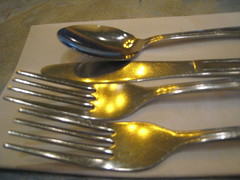
Plain Utensils...Image by MyEyeSees via Flickr

Every year, on Thanksgiving morning, I polish the family silver. This year, the task took on the power and meaning of ritual.

Knives, forks, spoons; dessert forks, butter knives, serving pieces. I soak everything in the kitchen sink in warm sudsy water. Then, with paste silver polish and that funny sponge that comes with it, I polish each piece, and then set it in the other side of the sink, in clear water. Some of the pieces are hardly tarnished at all, while others are very discolored. Each piece gets an inspection and at least a once-over with the silver polish. When I finish, all the silver is gleaming. It gets a final rinse in hot running water, and a last inspection before drying each piece with a soft cloth, then placed on the table. First the place settings, then the large serving spoons are staged about the theater. Dinner is show time and go time.

I've grown to love this chore, the older I've gotten. I remember my mother taking out the silver when my cousins and their parents came to visit for the holidays. The polishing was a task given to the children, and come to think of it, was probably the best way of keeping a bunch of kids busy and out of the way. This year, as I polished, I thought of all of those children. I also thought of my grandmother as a young bride. This was her silver, wedding presents given at the turn of the 20th century. She had five children and was married more than fifty years. She must have used this service countless times. Did her children polish it, or was it for the maid to do? Who sat around her table, sharing holidays and everyday meals with the family, year after year?

That's the thing about performing a mindless task -- your mind wanders all over the place. Random thoughts, memories, curiosities are evoked in the action, whether it's polishing silver or "chop wood, carry water." I felt connected, via the silver and the act of polishing, to the past, present, and future. The meal, the friends, their families near and far, on and on, all formed a dense web of interconnections through space and history that I could actually FEEL. Simple objects, actions, and awareness are the touchstones for reviving these connections. They help us -- me -- to recognize a profound sense of sacredness in the everyday.

As I pondered these connections, via silver polishing, I realized that the work of a Feldenkrais teacher is about helping people to make unexpected connections. The gentle movements seem kind of mindless and repetitive, and they usher you into a state where your mind can wander. Typical patterns are interrupted, and new sensations pique interest, curiosity, and appetite for more. People sense connections within their own bodies: for example, the way your feet contact the floor can be sensed in your jaw and neck -- and return to an almost childlike amazement at how "new" they feel.

The act of ritual doesn't have to be mindless or compulsive. Any action, repeated mindfully, can become a vehicle for improvement, possibility, connection, and creativity. The work of Moshe Feldenkrais is a method of intelligent, mindful action. Last weekend, it leaped up off of the floor and into my sink with the silver polish. I felt, and feel, extremely appreciative for all of it.
Reblog this post [with Zemanta]

Stumble Upon Toolbar

Wednesday, November 25, 2009

The Neuroscience of Mindfulness

b.Image by [Adam_Baker] via Flickr

Thanks to Melissa G. for bringing this recent post from a blog on the Psychology Today" site.
The Neuroscience of Mindfulness by David Rock.

As a person who was interested in mindfulness and meditation for years, but failed miserably in each attempt, I was very grateful to "stumble into" the Feldenkrais Method. As Dr. Rock's article states,

"The key to practicing mindfulness is just to practice focusing your attention onto a direct sense, and to do so often. It helps to use a rich stream of data."


The longer I practice the Feldenkrais Method, the more appreciative I am of the value of my senses and the information I process through my own body and perceived experience. That starting point -- what's happening here, and now -- is the best first step on whatever journey you're on.

Learn more about the Feldenkrais Method here.

Stumble Upon Toolbar

Thursday, November 19, 2009

We're on TV! High Heels Workshop

Watch our recent appearance on "Mirror, Mirror" with Rebecca Spera, as seen on ABC's LiveWell HD TV Network. Be sure to have your sound/earphones "on."


Now I know what shoes to buy! AND our next High Heels Workshop is December 6!
Click here for information and to register online.

Stumble Upon Toolbar

Wednesday, November 18, 2009

Problem Solving, Part II

RESONANZ0912Image by divamover via Flickr

After my post here on November 16 about "Point of View and the Feldenkrais Method," which dealt with problem-solving (read it here), it's exciting to see this new article:

ScienceDaily (2009-05-13) -- Swinging their arms helped participants in a new study solve a problem whose solution involved swinging strings, researchers report, demonstrating that the brain can use bodily cues to help understand and solve complex problems.

According to lead researcher and professor Alejandro Lleras:

The new findings offer new insight into what researchers call "embodied cognition," which describes the link between body and mind, Lleras said.

"People tend to think that their mind lives in their brain, dealing in conceptual abstractions, very much disconnected from the body," he said. "This emerging research is fascinating because it is demonstrating how your body is a part of your mind in a powerful way. The way you think is affected by your body and, in fact, we can use our bodies to help us think."

Dear Reader: please picture me, a Feldenkrais teacher, doing handsprings and saying, "HA!"

Read the article here.

Reblog this post [with Zemanta]

Stumble Upon Toolbar

Monday, November 16, 2009

Point of View and the Feldenkrais Method

In the "Is the glass half empty or half f...Image via Wikipedia

Words matter. Word choices matter.

The spirit in which words are chosen matters. It all depends on the topic and your point of view to determine whether the search for finer distinctions is an engaging exploration, or arbitrary nit-picking and hair-splitting.

So, I began to wonder about the distinctions between "problem solving" and "solution finding." Point of view, intention, and habitual ways of perceiving can make a big difference in whether, or how, you change your situation to the better. It's a similar stance to your personal view of "is the glass half empty, or half full?"

People come to me with problems. They have pain, or difficulty, or impaired function. They have a desire for things to be different, and better, for them. In part, the Feldenkrais Method shifts the attention away from the problem or deficit, and toward solutions. Not just "a solution," or "the solution," but to come up with multiple solutions. The situation improves, not by ignoring or denying the difficulty, but by working (or playing) with it to transform it.

Each Feldenkrais lesson is an experiment in problem-solving/solution-finding. Each lesson begins with a small, gentle, safe, comfortable movement of some part of your body. Gradually, you realize that that part of you is connected to some other part of you, and it moves, too. The task is to find the simplest, most comfortable, most efficient and economical ways to allow the movements to change, and grow. You don't have to figure it out on your own. Your Feldenkrais teacher guides and facilitates the process. You find solutions that work for you. Or, you begin to learn a process for finding solutions in the future. It's all good.

I find that focusing exclusively on the problem side of the equation makes the problem grow, and even multiply. People get stuck with a problem because they can't find a way to change it. I love the exploratory action of the Feldenkrais Method, because it accesses each person's curiosity and creativity. Some folks have not accessed their curiosity and creativity since they were small children.

The catalyst for the creative process is the question, "What else?" What else could you do? How else could you do it? For example: whatever you are doing, try doing it:
  • slower
  • faster
  • smaller
  • larger
  • smoother
  • "jagged-er"
  • shorter duration
  • longer duration
  • looser
  • tighter
  • in reverse
  • sitting, standing, walking, staying, lying down: on front, on back, on side (change your position)
Get the idea? Your actions and your thinking will begin to take on a Dr. Seussian quality: could you do it in a box? Could you do it with a fox? However, if you pay attention to what happens with each variation (your "results"), and incorporate what you liked best about each, something new will begin to emerge. Add the aspects that work well. Eliminate the aspects that don't work. There are almost endless possibilities and variations. You just have to take time to play to discover them.

All of this pre-supposes that you know what you're doing in the first place, before you start changing it. As Moshe Feldenkrais said, "If you don't know what you're doing, then you can't do what you want." His work incorporates a hardy optimisim that things can always improve. The Feldenkrais Method sees your glass as half full, and endlessly refilling. "Another round" is always on the way.
Reblog this post [with Zemanta]

Stumble Upon Toolbar

Monday, October 19, 2009

Wise Words/DUH!

Yellow OnionsImage via Wikipedia

For a frequent giggle and a good perspective-changer, I read The Onion online. It's a satire publication, focusing on news stories that are either made up, or not news at all ("Local Man Thinks First Date Went Well"). How does this compare with regular news outlets? First, The Onion is funny. And secondly, their stories often ring true with just the amount of accuracy and irony to make you stop and think. A lot of it falls into the category of juvenile, rude, college humor, so sometimes it's not for the easily-offended.

A story last week caught my eye, and I just had to share it. You can read it on The Onion here. But here's the main text of the article:

Study: Majority Of 'Calm Downs' Ineffective

October 12, 2009 | Issue 45•42

ITHACA, NY—A study published recently in the Journal Of Mental Health found that attempting to reverse a loud emotional display by asking an individual to calm down was effective only 9 percent of the time. Researchers at Cornell University's behavioral lab induced anxiety in subjects by administering a series of electric shocks, after which everyone was told to "calm down" and "take it easy." "We were surprised to find that not only were these phrases ineffective, but in an overwhelming number of cases they actually exacerbated the situation," psychologist Kenneth Pulaski said. "Even when participants were told to 'just take a deep breath,' they became more and more irate and were eventually reduced to a screaming mess." The study also concluded that telling someone to "just mellow out" would invariably lead to a researcher being punched in the face.


This is a wonderful finding, and thank goodness research has "proved" it, finally! Point noted. Check.

Have you also noticed that, as a professional brings your attention to your tight muscles or pain, they often tell you that you "just need to relax" or "stop holding" or "stop resisting?" It's the same thing, isn't it? The problem is, most people have FORGOTTEN how to "relax." If you knew how to do it, you'd be doing it, right?

There's another problem with this whole "relaxation" idea. Deep down, we know that the state of total relaxation you feel during a wonderful massage, or the momentary zombie-like feelings right after a Feldenkrais lesson, are not very useful, except perhaps for falling asleep! Our problem is that we have only two choices: either be a caffeinated, wound-up, stressed-out, Type-A maniac, or be an unconscious puddle of invertebrate goo somewhere on the floor. Most people realize, at some level, that total relaxation is not a real solution for navigating the demands of daily life.

There is good news, however. Just as you may have forgotten what easy, pain-free, effortless action (much better, distinct from "relaxation," wouldn't you say?) feels like, you can RE-LEARN those sensations and find some relief. That's where movement education, or re-education, is valuable, and that's what The Feldenkrais Method teaches. That's why I don't tell my clients to relax. Students of the Method re-learn the patterns of moving, feeling, and sensing that are part of our human birthright.

Moshe Feldenkrais wrote a fascinating book, entitled "The Elusive Obvious." In it, he explores an essential human folly: we find one good idea, and expect to apply it everywhere and from henceforth, with uniformly positive results. However, this is rarely the case. The book gets you thinking more deeply about your unconscious assumptions about yourself and the world around you. The idea of The Onion's made-up research study is one of those "elusively obvious" notions -- one you might not have thought of before, but leads to a dawning awareness.
Reblog this post [with Zemanta]

Stumble Upon Toolbar

Monday, October 5, 2009

Making Sense of Life

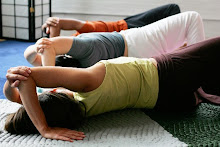
Feldenkrais Awareness Through Movement(R) lessonImage by divamover via Flickr

Life is interesting.

Through good times and bad, great joys and great sorrows, all we can do is make the best sense of it we can.

It is this "making sense" that so intrigues me, and to which I have devoted my life and work. It seems that we have all learned to separate what is going on in our thinking processes (logic, linear progressions, judgments, or imaginations) from what is going on in our bodies. Most people (especially Baby-Boomers, newly perceiving themselves -- ourselves -- in decline) come to see their body as a maintenance problem, constantly to be exercised, strengthened, stretched, moisturized, conditioned, fueled, satisfied, and monitored for signs of impending doom. Everything that goes in or comes out of our bodies is scrutinized, and we actually FEEL very little of what goes on. How much obesity occurs because the person cannot feel the sensation of fullness, or satisfaction? How many injuries occur because painful warning sensations are ignored? My continuing fascination with the Feldenkrais Method usually comes back to the interplay within the system of moving, thinking, feeling, and sensing. Improving our sensitivity to our senses can help us to "make sense" of the world around and within us.

Here follow three stories of people "making sense."

Divergence Vocal Theater presented their third artistic collaboration and multi-inter-extra-disciplinary production this past weekend. Their performances defy description; even their self-proclaimed status as "Houston's renegade, indie opera company" doesn't do it justice. Artistic Director and Founder Misha Penton embraces her vision to let more and more of the experience evolve for her performers and her audience. The evening was a mix of contemporary vocal and instrumental music (harp, sitar, and piano), spoken word, modern dance, and stunning visuals created through lighting, film, and long diaphanous strips of colored fabric. The fabrics, in warm oranges, taupes, and sages, stretched the length and breadth of the performing space, on the stage and in the audience; constantly changing, weaving, carried, carressed, abandoned by the performers. The entire evening, around the theme "Autumn Spectre," was one of achingly beautiful sensory demand. The performance defied all traditional expectations of making sense, if you needed a story line, characters, conflict, or moral. However, sense was made in the way love is made, one delicious sensation at a time. Each person made their own sense. Even seated in the space, all were moved.

***

The little girl is four years old. She is bright, funny, cheerful, and beautiful, and every day is a struggle. Because of a rare anatomical defect in her brain, she has not yet sat up by herself, crawled, or supported her weight to walk. With gentle playfulness, we access her own deep knowing of how to move. We explore the human developmental sequence, picking up at about 6 months of age, where the limits of her brain structure reached and then sort of stalled. With each movement, lifting the head, or tucking the chin, or bringing knees up over her belly to roll back and forth, her brain is making new connections, finding "ways around." Her sensations give her input on which to build toward the next part of the sequence. She rolls over onto her tummy much more easily and readily. It's a thrill to see her roll her pelvis then so that one knee can begin to bend and come up alongside, then under her. Her family and I are banking on neuroplasticity -- the ability of the brain to change, grow, and adapt to useful input -- and we are seeing progress. We are all making sense -- discovering it, sensation by sensation -- the best way we can. Who knows where it will lead?

***
It's a lovely fall Friday evening in Houston, and happy hour is underway. Self-identified geeks -- a mix of web and software designers, programmers, photographers, and other technophiles get together for beverages and conversation at our favorite Midtown watering hole, The Coffee Groundz. Another group intermingles with them -- people who get together quarterly with the sole purpose of socializing while wearing tiaras. The Venn Diagram of the two groups has a surprisingly large overlapping center. Frivolity reigns. There's nothing like a group of people together relaxing and having a good time. One can sense that these people work hard. They play with great dedication. They'll go forth to conquer the world again on Monday.

***

Take a breath, try something new. Use your powers for good. By feeling your way, you're bound to make sense of some of it.
Reblog this post [with Zemanta]

Stumble Upon Toolbar

Monday, September 28, 2009

The Right Combination

Recently I had the opportunity to revisit an interview of Moshe Feldenkrais on the subject of actor training and the benefits for actors in the Feldenkrais Method. And it got me to thinking -- how people of wide varieties of interests can benefit from these insights directed at actors. With the supremacy of specialization, we are highly likely to become trapped in the echo chamber of ideas that are virtually identical to our own. When I find something useful from another field, it brings a breath of fresh air to my own. (A link to the interview appears at the end of this post.)

And so -- one aspect that Dr. Feldenkrais and the interviewers discussed was the idea of relaxation. You may be familiar with the notion from athletics, acting, or music that the performer must "stay loose" or relaxed. We all know that we probably need to stress less, and well-meaning advice comes from all quarters to "relax." Yet, we know less and less how to do that!

We also view relaxation and stress as a binary, all-or-nothing function. We picture the caffeine-crazed, hair-standing-on-end, wide-eyed, wound-up, in-pain version of ourselves. The only alternative we can imagine is the semi-conscious puddle of goo, the wet noodle, the about-to-fall-asleep self. Feldenkrais draws some useful distinctions.

As Feldenkrais observes in the interview, the state of total relaxation is not very useful -- unless you are trying to fall asleep! If you were "totally relaxed," you wouldn't have enough get-up-and-go to accomplish anything. The Feldenkrais Method helps people to discover something he called "eutony:" the capacity to sense, with comfortable precision, the appropriate amount of muscular effort needed to accomplish a desired action. The undesirable choice between "Burn Out" or "Rust Out" is expanded into a much more practical and diverse spectrum of virtually limitless options.

Eutony, then, is something you recognize when you experience it. It actually feels -- GOOD. You might need some practice to find new choices for yourself, other than StressGirl or NoodleBoy. That's what our classes and lessons in the Feldenkrais Method are for. You'll find your own right combination of action, attention, and ease that makes all aspects of your life more enjoyable and sustainable.

Read the article, "Image, Movement and Actor: Restoration of Potentiality," a discussion of the Feldenkrais Method and Acting, Self-Expression and the Theater here.


Reblog this post [with Zemanta]

Stumble Upon Toolbar

Monday, September 21, 2009

Learn to Learn


I recently came across an article by Moshe Feldenkrais on the website of the Feldenkrais Studiengesellschaft of Vienna.

The subtitle of this breezy and brief article is "A manual to help you get the best results from the Awareness Through Movement lessons." You'll find his advice has much broader applications.

In just a few short paragraphs, you'll be challenged to QUESTION everything you've ever thought -- or been told -- about effective learning.

Read the article, then try the Method. We can support and assist you. What do you notice? What are your results?

Please copy and paste this link into a new window.
http://www.feldenkrais-wien.at/article-1.htm
Then, please come back here to comment.

Reblog this post [with Zemanta]

Stumble Upon Toolbar

Monday, September 14, 2009

Congress, Tennis, and Music

The US OpenImage via Wikipedia

A curious juxtaposition of events last week has gotten me thinking.

It's been an interesting time to be an observer of human behavior.

A U.S. Representative made a public outburst during a Presidential Address to a joint session of Congress.
A world-ranked tennis player threatened and verbally abused a line judge after an accurate call.
A rap star hi-jacked the MTV Video Music Awards and discounted the achievements of a fellow performer and award recipient.

Crystallized in these three examples, we can see the cultural consequences of a widely-held belief. That belief is: Making other people "wrong" is an effective problem-solving strategy. The accompanying belief is: above all, be "right."

Just look around you, and you'll see a lot that is wrong. Do you remember how you felt the last time someone told you that you were wrong?
Did you begin to defend your point of view?
Did you also point out something that was wrong with the other person?
If the person was in authority over you, how did you feel?
If the person was NOT in authority over you, how did you feel?
Was anything resolved? Did anything change?
Strange as it may seem, people don't generally appreciate it when someone else points out that they are wrong.

Making someone wrong is a sure-fire strategy for either 1) creating a deadlock or 2) damaging a relationship.

Most of our educational system is based on correction. Education in the arts, in high-performance sports, and most of our health care is consumed with fault-finding and correction. Small wonder that faults proliferate, and improvements are few. You can't find improvement if you're not looking for it.

What if it were possible to tell the truth, (or your part of it) without making someone else wrong?

It seems that when we're not busy making other people wrong, we're busy making ourselves wrong. We believe that we need correction, that if we could just do everything "right" our lives would be perfect. We make all kinds of unnecessary purchases from any outfit that promises to correct our defects. Some people make their living by inventing defects to correct. We chase around looking for people to tell us what we should be doing -- and then resent the hell out of it whenever someone does. We lose faith in ourselves, and in other people.

The Feldenkrais Method is unique in its fundamental respect for each individual. (Thanks to my colleague, Dan Schmidt, for providing the catalyst and the tie-together on his blog.) Our process of dealing with balance, gait, posture, or pain management, is not to correct ("Do it THIS way), but to present constructive and creative possibilities ("How could this be possible? What's another way? Which way feels better?") from which a person can act and choose. We do not coerce, force, pressure, shame, or "motivate." We make exploration, inventiveness, and learning irresistible.

Our results are often astonishingly effective, successful, and achieved with simplicity. Part of the design of our process is in asking productive questions.

One Facebook post this week asked, "Where do you stand? Are the Republicans idiots? Are the Democrats dangerous?" These questions only further entrench people in their own positions. What if people started asking, "What is of value here? What does each stakeholder need to be able to move forward? How COULD this work?"

Watch your own habits and behavior this week. Does it seem that a lot of people around you are "wrong?" Or certain groups of people? Do the same sentences keep echoing around in your head, the same emotional tone arises? What if it were possible to feel different -- to feel better?

The potentially profound effect of the Feldenkrais Method is in the way that movement becomes metaphor. Rigidity in movement often correlates to rigidity in thought. You can learn to open your mind, and move forward.


Reblog this post [with Zemanta]

Stumble Upon Toolbar

Sunday, September 6, 2009

Labor Day Weekend

This is an image taken from a typical PET acqu...Image via Wikipedia

It's a lazy Sunday afternoon. The cats are asleep in the shade on the patio, and I've been flirting with the idea of a nap all afternoon. A little TV, a little reading, a little cooking. It's remarkably easy to entertain myself, and I hope to spend MOST of tomorrow completely "unplugged," disconnected from phones and computers. That will be a big change for me. I'm not sure I can do it.

The value of a long weekend is in being able to rest and relax. It's also an opportunity to have a change from routine: perhaps you sleep in, or get up earlier than usual for a special activity. A movie, a cook-out, a little trip or a chance to stay home -- any change in your habitual pattern can re-charge your energies. Your nervous system benefits enormously from these regular, but not too frequent, interruptions in the usual routine.

People often remark after their first Feldenkrais class that it wasn't what they expected. Yet, they don't say this with disappointment. They are curious, interested, and surprised at how easy, fun, and unusual it was. They are also fascinated to discover some new sensation, or ability, or capacity that they didn't know they had. The class provides the same benefits of a long weekend, but in condensed form. The break from routine, the discovery of the unexpected, the enjoyment of something different, keeps your body and your brain in shape, ready for the next challenge.

I hear the gentle rumble of thunder in the distance, and it's beginning to rain softly, a rain we really need. Maybe I'll take that nap after all. . .


Reblog this post [with Zemanta]

Stumble Upon Toolbar

Monday, August 24, 2009

Monotony/Mono-toe-ny

Wheel mouseImage via Wikipedia

There's nothing like completing a big project to make you feel -- like you've completed a big project. After I recover from the exhaustion, I will celebrate. But first, I need aspirin. Let me explain.

I spent the weekend doing the tedious but necessary work of transferring 160 digital products to a new shopping cart, part of the secret life of an e-commerce mogul. That's intended as an ironic statement, since I am a one-person, self-employed show. The project had been on the back burner for months, and an open stretch of time appeared. I hunkered down.

Luckily, there was not much typing. However, there was a lot of "highlight - copy - paste - next." Over and over and over and over. . . let's say, there was a pattern. It took me about two minutes to go through the entire process for each entry. That's a little over five hours on data entry. I spread the tasks over two days, took frequent breaks, and ended up with a fully-functioning and re-designed web site after about 15 hours at the computer. And I realized, once again, that humans are not suited for monotony.

I noticed the physical effects within the hour. My wrists and fingers began to tingle. My thumb began to hurt. Luckily, the only slave-driver boss I had to please was myself, and I'm a Feldenkrais teacher. I set a timer for 30-minute intervals, and made sure to get up and walk around for a few minutes during the breaks. I began to explore different ways that my "mouse wrist" could stay softly bent away from the mouse, rather than resting on the desk or wrist-rest. I also wondered -- am I using more force or power than is necessary? What was the least amount of "impact" needed for my finger to click the mouse, for my wrist and thumb to guide, for my hand to grip? I began to feel the connection of my hand to my whole arm, and to my shoulder, seeing where I could soften, and allowing my pelvis to shift and roll on my chair. I looked for small variations that I could incorporate so that my movements did not become rigid and rote. If I had not had this awareness and movement training, I could easily have gotten myself into some serious and long-term pain. These repetitive motion strain injuries are leaders among workers compensation insurance claims.

During my escapes to do errands, I noticed that I was mentally sluggish. I wandered around the grocery store in more of a daze than usual. I was preoccupied with the task back at the office, thinking of the monotonous pointing and clicking even as I surveyed the artichokes. I wondered -- am I too impaired to drive? I felt the pull back to the office. Must. Complete. Mission. Must. Click. Mouse.

The word "monotony" has the same origins as "monotone," or "one sound." Our nervous systems actually become "tone deaf" when we don't have enough harmonious stimulation, or several melodies to make the day's song interesting. Variety is the spice of life, and it's also what your brain needs to stay vital and engaged.

Those monotonous hours put my brain into a dulled, unresponsive state. As I was preparing for dinner, a big, heavy dish slipped out of a low cabinet and fell onto my toe. Had I broken my toe? This was not the kind of "break" I wanted to take! Now, my focus was even more "mono-toe-nus." After the required expletives, my throbbing toe dominated my senses, my awareness, my self-image. The pain from my toe was the brightest blip on my internal radar, and I felt like my entire body was just one, gigantic, throbbing, possibly broken, toe. Ice, please. More expletives. Elevate. Dinner.

The happy ending is -- the dish is fine. My toe is not broken, just badly bruised. A few aspirin and keeping it elevated has helped a lot. And, the computer task blitz is completed. I look forward to my Feldenkrais classes this week, to bring my self-image and my brain back to a harmonious state, free of monotony -- in every sense!


Photo by Chris Welsh, "MaryBeth's toe."

The website construction that led to my injury is DictionHelper.com . MP3 audio downloads of foreign-language pronunciation for beginning classical vocalists, resources for singers, and podcasts.

Reblog this post [with Zemanta]

Stumble Upon Toolbar

Sunday, August 2, 2009

Housecleaning

Buster Brown cleans up the houseImage via Wikipedia

Last week, I treated myself to a real splurge.

A fancy dinner? Spa treatment? Retail therapy? No, something even more decadent.

I hired a maid service to come and clean my house.

This was even more of a splurge because the place was in fairly good shape. We keep things pretty well picked up and presentable. However, there were lots of little things that perhaps nobody else would have noticed, but I was feeling dissatisfied. And, with a busy life, career, and appointment schedule, all but the most basic cleaning and straightening goes undone. It was time!

I had mixed feelings about calling a maid service. I still remember, long ago, my mother cleaning along the bathroom baseboards with an old toothbrush. And I also remember her saying, "If I don't move anything, then you can't tell how dusty it is." Needless to say, those two extremes are hard for me to navigate. After returning from travels and launching into some major work and volunteer projects, I decided it would be more valuable for me to hire out for the cleaning so that I could focus on other things. I called the Keep It Green Maid Service, an eco-friendly mom-and-pop operation, and felt good about my decision to "Support Local, Grow Together."

Now, I am filled with a convert's zeal. I'm more aware of the new standard of cleanliness (nearer to godliness are we!) and so it's pretty easy to keep. However, I know that time will pass, I will get busy, I will pay less attention, and things will begin to deteriorate again. Life happens, and stuff along with it, and dust and clutter. I'll need the Keep It Green Maids to come back in another month. I'll also get them to teach me some workable strategies for keeping things under control between our sessions.

It occurred to me that learning, especially the kind of learning we do in the Feldenkrais Method, is kind of like having your house cleaned. To keep the changes, you have to pay attention. You have to remember how it was, and how you wanted something better. And then, you have to do just a little bit each day to be able to maintain the awareness and the results. A Feldenkrais lesson provides a gentle but thorough housecleaning of your movement patterns. Those aches, pains, or klutziness are like dust and grime that keep things from going smoothly. Your Feldenkrais lesson will leave you feeling calm, focused, and in improved condition. Sometimes, you need a pro.

Reblog this post [with Zemanta]

Stumble Upon Toolbar

Sunday, July 26, 2009

On Human Interaction

Position ClosedImage by Jon Wiley via Flickr

This blog post is an experiment to see whether the person who monitors social media for United Airlines is watching their Google Alerts or Twitter search feeds. I don't have a formal grievance, and I'm not looking for anything from you other than the acknowledgment that you are paying attention, and taking steps to once again be able to invite people, without irony, to "fly the friendly skies of United."

I flew those purportedly friendly skies on United yesterday (Saturday, July 25, 2009), and actually found them to be pretty unfriendly. Other adjectives: indifferent, unconcerned, irritable, grumpy. I was exhausted, queasy from my cab ride to the Albany airport, and needing a little help. I assumed a submissive posture, tried to stay out of the way, and did my best to smile. Alas, my efforts were not reciprocated.

To their credit, United delivered the basics: air travel that takes off and lands safely. Both of my flights had the additional benefit of departing on time. The second flight actually arrived in Houston a bit early. I am very appreciative of those details we often take for granted, so thank you. However: United Airlines is apparently completely unaware that the current business climate requires more of a company than simply meeting the minimum standard. They are apparently also unaware that their brand is in trouble. Someone needs to intervene, and fast. United: get busy training your employees to value the customers you have, and to do right by them. Re-brand yourself to be identified with fantastic customer service. You might survive. Until then, customers have choices. Just sayin'.

I understand that the company is in trouble, and that your employees are as worried as everyone else about their job security and how far their salary doesn't go. I get it that it's irritating when the infrequent fliers (like me) haven't looked at the web site to be aware of new policies. I also get it that these employees work for long hours at low pay, and probably wanted to be home with their families instead of working the early shift on a Saturday. I accept responsibility for my part of my own difficulties yesterday. I could have avoided the shock of a last-minute charge if I had looked at the web site for their carry-on and baggage check policies. I would have made different choices for how I packed. Despite the fact that I teach an awareness practice (the Feldenkrais Method), it doesn't make me perfect, or aware of EVERYTHING. I became aware -- I learned -- that there's a lot more to traveling well in the current economic climate than in simpler times.

A friend recently reminded me of a quotation that should be part of every company's customer service training. "Be kinder than necessary-everyone you meet is fighting some kind of battle."
Customers are doing the best they can. Traveling is stressful. Airline patrons are traveling to funerals, on family emergencies, traveling with children, traveling without children, traveling for work; pre-occupied, tense, self-absorbed. They just want to get where they are going, and a little human kindness can go a long way. I've long been an advocate of service employees who have to put up with surliness from The American Public on a daily basis. The person who can persevere on the job and stay calm, friendly, and helpful, is a treasure to the company, and a blessing to each customer. Each person just wants some quality in human interaction; some empathy, some kindness, no matter where they are. And especially if they are about to be inconvenienced.

So, United: here's what would have been nice:

Instead of: "You have to check that bag. You can only have two carry-ons," and "It's $20 to check the bag."
It would have been nicer: "I'm sorry, Ma'am, but you're only allowed two items to carry on. May I take that for you?" and "Unfortunately, we've had to adopt a policy of charging for checked baggage, even on the first item. Would you like to try to re-pack your carry-on so everything fits in the one bag? Otherwise, the fee is $X."

Instead of: irritated attitude and disappearing act when the last bit of my drink spilled after a bumpy patch, and I rang the call button for the flight attendant to bring some paper towels.
It would have been nicer: "Oh, let me help you with that. Here are some paper towels. Do you need some more? I'll be right back. May I take that blanket for you, it's probably wet, too. Let me see if I can find you another one. Would you like another Coke?"

Instead of: "Yeah, you'll really have to run for it now" after a delay at the arrival gate at Dulles, when the flight attendant knew of my tight connection to Houston.
It would have been nicer: "Oh, so sorry for the delay, you'll really have to hurry. I'll call over to the gate for your connecting flight and tell them you are on your way, and to please hold the flight for you."

Unfortunately, United Airlines, you have a bad reputation. Grousing on Facebook about my travel woes (a canceled flight on the front end, and unhappiness on the return) unleashed a torrent of unsolicited shared bad experiences with the airline and its customer service. A quick search of the Twitter stream for @UnitedAirlines reveals about one positive comment for 9 or 10 negatives. In tough times, your employees AND your customers are your sales staff to generate future customers. It is essential that they do a good job for you, and understand how vital they are to your success. Relationships and referrals are the only way to build a happy and loyal customer base. It's not hard, and it doesn't take much time. Best of all, it costs nothing to be kind. Small things, like a smile, tone of voice, eye contact, warmth, and attention, are valuable "smoother-overs" in almost any situation. Good news travels in social media with the same speed and enthusiasm as bad news. Just imagine when the online chatter says "I had the most fantastic experience on United, of all places," and "The folks at United went out of their way to help me in a difficult situation." Comments like that could transform your company and its fortunes.

Fortunately, I receive few complaints in my business. But when I do receive one, I do my best to apologize and then make it right. Relationships and referrals are everything to the small business person, and I try to make sure that everyone is treated well. So United, here's the deal: most complainers don't want to be difficult, or to make your life miserable. They want you to get better. They want you to get your act together so that they can do business with you again. They want everyone to be happy. Learn from your customers. They know how you're really doing.

"Be kinder than necessary-everyone you meet is fighting some kind of battle." The root of kindness is compassion. Compassion grows from awareness. Customer service makes the difference when times are good. It is golden when times are tough.

Click here for video from my flight on United, Dulles to Houston.


Reblog this post [with Zemanta]

Stumble Upon Toolbar

Reflections on RESONANZ


It's not often that you get an opportunity to fall in love with 25 people all at once. That's why I am still treasuring the memory of my week in Albany, NY, at the College of St. Rose Massry Center for the Performing Arts. Wonderful musicians and artists have gathered for three weeks of learning, self-development, and new perspectives at RESONANZ.

Metropolitan Opera mezzo-soprano Heidi Skok envisioned a summer festival and training program where students and faculty could experience something different from the typical "grind" of coach-practice-perform-stress that is typical of such programs. Her inspiration came, in part, from the tragic suicide of a colleague, Jerry Hadley, in 2007. She reflected: Why must performers feel so desperate? What ingredients are missing in training, or in life? At RESONANZ, she has created an atmosphere of sincere caring, mutual respect, and joy in performing. The student artists receive mentoring, coaching, and honest feedback from top-flight faculty with impressive performing credits. These folks have got the goods.

The unique feature of RESONANZ is its emphasis on each singer as a whole person. I was honored to contribute the perspective of the Feldenkrais Method in classes during the first week of the program. Students and faculty participated in a daily Awareness Through Movement class, as well as in meditation training from Lance Brunner from the University of Kentucky. They will have the opportunity to incorporate the benefits of a yoga practice in the coming weeks, taught by Albany area teacher Susan Hoffman. This ain't your standard opera training program.

Whatever your field of interest, from sports, or opera, cooking, or knitting, there's always the temptation to fall into narrow thinking about it. It's rarely just about how much you "know;" it's about how much you can learn. Learning offers an open and dynamic process and perspective; "knowing" can turn rigid and dogmatic if you're not careful. At the beginning of the vocal masterclass I presented last Thursday, I shared part of one of my favorite poems:

Out beyond ideas of wrongdoing and rightdoing,
there is a field. I'll meet you there. (Rumi)
I invited the singers and the audience to meet in that field. To include other points of view and new experiences in their thinking. To develop an expanded "movement repertoire" that will permit freedom, comfort, expressiveness, and enjoyment in performing and in living. To expand their notion of "THE one, right way" to include their very own versions of several ways that work pretty well. Each of the three singers discovered new freedom, new sound, new capacity. The audience witnessed the transformation of each person, not just each song. Tears of joy flowed as they experienced "Making the impossible, possible; the possible, easy; and the easy, elegant." This ain't your standard opera masterclass.

The Feldenkrais Method offers concrete experiences of exploring and experimenting with new ideas. For some, the new idea is that you are an interesting, wonderful, and worthy human being. For some, the new idea is that performing does not have to be an expression of ego: it can be a demonstration and expression of LOVE. When you are more aware of yourself, you will be more aware of others. You can use your powers for good. A Feldenkrais class is a laboratory for learning how to turn intentions into actions. Embodied, intelligent action is the foundation for excellence in whatever you pursue.

Reblog this post [with Zemanta]

Stumble Upon Toolbar

Sunday, July 12, 2009

Local, Global, Local


Each Feldenkrais lesson begins with an invitation to notice something. This noticing is gradually directed toward the observation of curious details about the way you move, rest, and solve minor problems. A movement that feels isolated, strange, and difficult quickly reveals itself to be easy, graceful, and that your whole self is involved. You learn a process of learning and exploration that can be applied in any setting. After awhile, most people report that the effects of the lessons have begun to generalize -- to "show up" as improvements in unexpected places, like their relationships, their work, their outlook. What began exclusively as a personal exploration of a specific issue eventually affects the world around you.

This ability to change your viewpoint, from local to global, or self to environment, and back again, is a crucial skill. Without it, you literally cannot move. A changing perspective gives a more complete view, and yields the opportunity to take intelligent action. Individual actions make a difference. Last week, I saw several examples of this, "on the ground."

One client, a zippy octegenarian, has a new lease on life. After two surgeries on the same shoulder and a slow recovery, she was discouraged with her lack of progress. After 14 months and several courses of frustrating and painful therapy, she still could not drive without pain, lift her arm overhead, or dress herself normally. After a little more than a month of Feldenkrais lessons, she has regained most of her range of motion, and can now drive and do household tasks without pain. She learned that her shoulder is connected to the rest of HER, and that when her whole self is involved in movement, her shoulder moves more easily. She has regained her independence and is now eager to get back to her social life. Another client, having survived a brain aneurism, still walks haltingly and has difficulties with balance. Our first lesson helped her to sense her ankles as she walked. She reported that later in the day, a friend told her she seemed to be moving better and with more stability. She was thrilled! One solution involved viewing the problem in a larger context; the other solution involved a seemingly minor detail that was an essential part of the whole. Both perspectives are needed for a fresh outlook and a new beginning. As Moshe Feldenkrais said, "The possibility of improvement is limitless." The cumulative effect of many small actions can lead to a big result.

Here's another story. Houstonians Ernie and Sheryl Rapp thought that our city should host its own version of the TED Conference, bringing the top creative minds to Houston to speak from their unique perspectives. They founded and launched The UP Experience ("Like TED, Only Hotter) in 2008. A second event is planned for October 15, 2009. Home-grown initiative and actions have resulted in an event of international caliber and influence. Through Ernie and Sheryl's creativity and dedication, locals will get a global perspective we wouldn't have had otherwise.

In another example, some Houston entrepreneurs, artists, and musicians have begun an initiative called "Support Local/Grow Together." It's a simple idea, really, do to business in your own community, with people you know, like, and trust. SLGT adds a personal, word-of-mouth, nice-to-know-you dimension to the buying decisions you make every day. Hang out at your local coffee shop, independent book store, or neighborhood mom-and-pop restaurant. Recommend your hairdresser, doctor, computer genius, or designer to your friends. You could purchase some fabulous vegetables at a farmer's market, get your printing done at a local shop, collect pieces by a Houston artist, seek out Houston musicians and performers for your next party. Attend a local conference, sample a new wine, follow your curiosity into new plans for self-development! (I recommend the Feldenkrais Method.) Again, the cumulative effect of many small actions can lead to a big result.

If you live elsewhere, you can begin to promote SLGT wherever you are. The "top down," big solutions to our economic woes are only part of the picture. SLGT is grass-roots, right in your own backyard. Global and local perspectives are points on a spectrum, and we must continually navigate between them. Individual actions, chosen with awareness and intelligence, will always make a difference.

You can become a fan of SLGT: Support Local/Grow Together on Facebook.


Reblog this post [with Zemanta]

Stumble Upon Toolbar