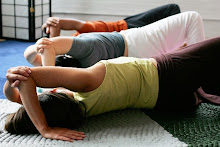
Watch our recent appearance on "Mirror, Mirror" with Rebecca Spera, as seen on ABC's LiveWell HD TV Network.
Now I know what shoes to buy! AND our next High Heels Workshop is December 6!
Click here for information and to register online.
Thursday, November 19, 2009
We're on TV! High Heels Workshop
Wednesday, November 18, 2009
Problem Solving, Part II
Image by divamover via Flickr
ScienceDaily (2009-05-13) -- Swinging their arms helped participants in a new study solve a problem whose solution involved swinging strings, researchers report, demonstrating that the brain can use bodily cues to help understand and solve complex problems.
According to lead researcher and professor Alejandro Lleras:
Dear Reader: please picture me, a Feldenkrais teacher, doing handsprings and saying, "HA!"The new findings offer new insight into what researchers call "embodied cognition," which describes the link between body and mind, Lleras said.
"People tend to think that their mind lives in their brain, dealing in conceptual abstractions, very much disconnected from the body," he said. "This emerging research is fascinating because it is demonstrating how your body is a part of your mind in a powerful way. The way you think is affected by your body and, in fact, we can use our bodies to help us think."
Read the article here.
Monday, November 16, 2009
Point of View and the Feldenkrais Method
Image via Wikipedia
The spirit in which words are chosen matters. It all depends on the topic and your point of view to determine whether the search for finer distinctions is an engaging exploration, or arbitrary nit-picking and hair-splitting.
So, I began to wonder about the distinctions between "problem solving" and "solution finding." Point of view, intention, and habitual ways of perceiving can make a big difference in whether, or how, you change your situation to the better. It's a similar stance to your personal view of "is the glass half empty, or half full?"
People come to me with problems. They have pain, or difficulty, or impaired function. They have a desire for things to be different, and better, for them. In part, the Feldenkrais Method shifts the attention away from the problem or deficit, and toward solutions. Not just "a solution," or "the solution," but to come up with multiple solutions. The situation improves, not by ignoring or denying the difficulty, but by working (or playing) with it to transform it.
Each Feldenkrais lesson is an experiment in problem-solving/solution-finding. Each lesson begins with a small, gentle, safe, comfortable movement of some part of your body. Gradually, you realize that that part of you is connected to some other part of you, and it moves, too. The task is to find the simplest, most comfortable, most efficient and economical ways to allow the movements to change, and grow. You don't have to figure it out on your own. Your Feldenkrais teacher guides and facilitates the process. You find solutions that work for you. Or, you begin to learn a process for finding solutions in the future. It's all good.
I find that focusing exclusively on the problem side of the equation makes the problem grow, and even multiply. People get stuck with a problem because they can't find a way to change it. I love the exploratory action of the Feldenkrais Method, because it accesses each person's curiosity and creativity. Some folks have not accessed their curiosity and creativity since they were small children.
The catalyst for the creative process is the question, "What else?" What else could you do? How else could you do it? For example: whatever you are doing, try doing it:
- slower
- faster
- smaller
- larger
- smoother
- "jagged-er"
- shorter duration
- longer duration
- looser
- tighter
- in reverse
- sitting, standing, walking, staying, lying down: on front, on back, on side (change your position)
All of this pre-supposes that you know what you're doing in the first place, before you start changing it. As Moshe Feldenkrais said, "If you don't know what you're doing, then you can't do what you want." His work incorporates a hardy optimisim that things can always improve. The Feldenkrais Method sees your glass as half full, and endlessly refilling. "Another round" is always on the way.
Monday, November 9, 2009
Lessons from Pooh
Image by Getty Images via Daylife
I'd been up and working for about 90 minutes and still had not made coffee. Update the website. Send the newsletter. Answer that email. Take the call. Each led to something else, something off-task but on point for what was interesting to me in that moment. I had to stop and take a breath -- and then updated my Twitter Status:
"The hurried-er I go, the behind-er I get. #WinniethePooh #Feldenkrais "
It was a revelation, really; one of those moments of awareness that put everything into perspective. It doesn't matter how long or how short the weekend is. It doesn't matter how many deadlines loom. It doesn't matter how many clients are booked in for the day. ANYTHING and EVERYTHING feels worse when I HURRY.
Hurrying and rushing are two hallmarks of stress. One of my favorite sayings of Moshe Feldenkrais is that it's possible to move quickly, without hurrying. WOW.
Do you feel rushed, stressed, on edge? How much do the words "Hurry" or "Hurry up!" creep into your vocabulary? Hurry is an unhappy merry-go-round that makes you and everyone around you stressed out. However, it's not hard to shift gears and find a better way.
We've come to associate speed with competitive urgency, rather than the joy of ease and agility. Pooh had it right. Sometimes the best way to catch up is to slow down. Hurrying allows errors and inefficiency to creep in. Pay attention to the quality of what you're trying to do. Those old tricks we know of making a chore into a game, or counting your blessings, or just taking a short breather, all work because they interrupt the pattern of rushing and stressing. You can't experience things differently if you don't change the pattern.
What are your stress patterns?
Monday, October 19, 2009
Wise Words/DUH!
Image via Wikipedia
A story last week caught my eye, and I just had to share it. You can read it on The Onion here. But here's the main text of the article:
Study: Majority Of 'Calm Downs' Ineffective
October 12, 2009 | Issue 45•42
ITHACA, NY—A study published recently in the Journal Of Mental Health found that attempting to reverse a loud emotional display by asking an individual to calm down was effective only 9 percent of the time. Researchers at Cornell University's behavioral lab induced anxiety in subjects by administering a series of electric shocks, after which everyone was told to "calm down" and "take it easy." "We were surprised to find that not only were these phrases ineffective, but in an overwhelming number of cases they actually exacerbated the situation," psychologist Kenneth Pulaski said. "Even when participants were told to 'just take a deep breath,' they became more and more irate and were eventually reduced to a screaming mess." The study also concluded that telling someone to "just mellow out" would invariably lead to a researcher being punched in the face.
This is a wonderful finding, and thank goodness research has "proved" it, finally! Point noted. Check.
Have you also noticed that, as a professional brings your attention to your tight muscles or pain, they often tell you that you "just need to relax" or "stop holding" or "stop resisting?" It's the same thing, isn't it? The problem is, most people have FORGOTTEN how to "relax." If you knew how to do it, you'd be doing it, right?
There's another problem with this whole "relaxation" idea. Deep down, we know that the state of total relaxation you feel during a wonderful massage, or the momentary zombie-like feelings right after a Feldenkrais lesson, are not very useful, except perhaps for falling asleep! Our problem is that we have only two choices: either be a caffeinated, wound-up, stressed-out, Type-A maniac, or be an unconscious puddle of invertebrate goo somewhere on the floor. Most people realize, at some level, that total relaxation is not a real solution for navigating the demands of daily life.
There is good news, however. Just as you may have forgotten what easy, pain-free, effortless action (much better, distinct from "relaxation," wouldn't you say?) feels like, you can RE-LEARN those sensations and find some relief. That's where movement education, or re-education, is valuable, and that's what The Feldenkrais Method teaches. That's why I don't tell my clients to relax. Students of the Method re-learn the patterns of moving, feeling, and sensing that are part of our human birthright.
Moshe Feldenkrais wrote a fascinating book, entitled "The Elusive Obvious." In it, he explores an essential human folly: we find one good idea, and expect to apply it everywhere and from henceforth, with uniformly positive results. However, this is rarely the case. The book gets you thinking more deeply about your unconscious assumptions about yourself and the world around you. The idea of The Onion's made-up research study is one of those "elusively obvious" notions -- one you might not have thought of before, but leads to a dawning awareness.
Sunday, October 11, 2009
Looking UP!

This week, it's my privilege and pleasure to attend a world-class gathering of "thought leaders" in Houston, The UP Experience.
How does MY attending a conference on October 15 affect YOU?
- it's a full day of listening (and talking, and eating, and meeting new people)
- listening (and that other stuff) leads to learning
- learning changes the brain
- when you change a brain, you change the world
I got involved with this event through my partner, Chris Welsh. He was involved with getting the first UP Experience on its feet in February, 2008, as a sponsor, founder, and recommender-of-speakers. This year, both of us were part of the speaker selection process, and the Feldenkrais Center of Houston is also a sponsor of The UP Experience this year. See the list of sponsors here.)
The UP Experience makes Houston the center of the "innovation universe" for one concentrated day. With 16 speakers
(Peter Diamandis
Anne Korin
Juan Enriquez
David Plouffe
Gavin Newsom
Brené Brown
Robert Ballard
Michio Kaku
Neil deGrasse Tyson
Tomasz Tunguz
Dan Ariely
Pattie Maes & Pranav Mistry
David Eagleman
Jenifer Fox
Peter Sheahan
Bruce Lipton) onhand, each speaking for 20 minutes about their consuming passion -- ideas will be more contagious than H1N1. Philanthrophy, business, astrophysics, economics, technology, neuroscience, government, medicine, education, psychology, exploration: The UP Experience offers more than a forum for wishing that the world could change. It's an opportunity to listen to people who ARE changing the world. The speakers are Unique People with Unique Perspectives (hence the name, UP) -- and so are the attendees.
The UP Experience is a dynamic system, much like the brain itself. The exposure to one new idea, one possible solution, one inspiriting person, has the power to change individuals, their businesses, their communities, and beyond. That's because learning causes change. Neuroscience confirms that the most fundamental of these changes happens in the chemical, structural, and functional activity of each brain. Even one new synapse has a ripple effect -- and YOU are in the "ripple zone."
I'm a retired opera singer and academic, now voice coach and movement educator. I could stay within the echo-chamber of my own professional organizations and interests, and would be busy and self-satisfied. However, I know I can make a better contribution to EVERYTHING I'm involved with when I have more input, more experiences, more ideas. You never know where an idea will lead, who will use it, or the difference it will make. How will learning about undersea exploration from Robert Ballard, crazy new gadgets from Pattie Maes and Pranav Mistry, or the dynamics of economic decision-making from Dan Ariely, affect my work, my blogging, my relationships? I can't wait to find out!
You can still register for The UP Experience here.
Monday, October 5, 2009
Making Sense of Life
Image by divamover via Flickr
Through good times and bad, great joys and great sorrows, all we can do is make the best sense of it we can.
It is this "making sense" that so intrigues me, and to which I have devoted my life and work. It seems that we have all learned to separate what is going on in our thinking processes (logic, linear progressions, judgments, or imaginations) from what is going on in our bodies. Most people (especially Baby-Boomers, newly perceiving themselves -- ourselves -- in decline) come to see their body as a maintenance problem, constantly to be exercised, strengthened, stretched, moisturized, conditioned, fueled, satisfied, and monitored for signs of impending doom. Everything that goes in or comes out of our bodies is scrutinized, and we actually FEEL very little of what goes on. How much obesity occurs because the person cannot feel the sensation of fullness, or satisfaction? How many injuries occur because painful warning sensations are ignored? My continuing fascination with the Feldenkrais Method usually comes back to the interplay within the system of moving, thinking, feeling, and sensing. Improving our sensitivity to our senses can help us to "make sense" of the world around and within us.
Here follow three stories of people "making sense."
Divergence Vocal Theater presented their third artistic collaboration and multi-inter-extra-disciplinary production this past weekend. Their performances defy description; even their self-proclaimed status as "Houston's renegade, indie opera company" doesn't do it justice. Artistic Director and Founder Misha Penton embraces her vision to let more and more of the experience evolve for her performers and her audience. The evening was a mix of contemporary vocal and instrumental music (harp, sitar, and piano), spoken word, modern dance, and stunning visuals created through lighting, film, and long diaphanous strips of colored fabric. The fabrics, in warm oranges, taupes, and sages, stretched the length and breadth of the performing space, on the stage and in the audience; constantly changing, weaving, carried, carressed, abandoned by the performers. The entire evening, around the theme "Autumn Spectre," was one of achingly beautiful sensory demand. The performance defied all traditional expectations of making sense, if you needed a story line, characters, conflict, or moral. However, sense was made in the way love is made, one delicious sensation at a time. Each person made their own sense. Even seated in the space, all were moved.
***
The little girl is four years old. She is bright, funny, cheerful, and beautiful, and every day is a struggle. Because of a rare anatomical defect in her brain, she has not yet sat up by herself, crawled, or supported her weight to walk. With gentle playfulness, we access her own deep knowing of how to move. We explore the human developmental sequence, picking up at about 6 months of age, where the limits of her brain structure reached and then sort of stalled. With each movement, lifting the head, or tucking the chin, or bringing knees up over her belly to roll back and forth, her brain is making new connections, finding "ways around." Her sensations give her input on which to build toward the next part of the sequence. She rolls over onto her tummy much more easily and readily. It's a thrill to see her roll her pelvis then so that one knee can begin to bend and come up alongside, then under her. Her family and I are banking on neuroplasticity -- the ability of the brain to change, grow, and adapt to useful input -- and we are seeing progress. We are all making sense -- discovering it, sensation by sensation -- the best way we can. Who knows where it will lead?
***
It's a lovely fall Friday evening in Houston, and happy hour is underway. Self-identified geeks -- a mix of web and software designers, programmers, photographers, and other technophiles get together for beverages and conversation at our favorite Midtown watering hole, The Coffee Groundz. Another group intermingles with them -- people who get together quarterly with the sole purpose of socializing while wearing tiaras. The Venn Diagram of the two groups has a surprisingly large overlapping center. Frivolity reigns. There's nothing like a group of people together relaxing and having a good time. One can sense that these people work hard. They play with great dedication. They'll go forth to conquer the world again on Monday.
***
Take a breath, try something new. Use your powers for good. By feeling your way, you're bound to make sense of some of it.
![Reblog this post [with Zemanta]](http://img.zemanta.com/reblog_e.png?x-id=45f30c07-3e9c-4bc4-9682-56a92839c173)
![Reblog this post [with Zemanta]](http://img.zemanta.com/reblog_e.png?x-id=c68b1983-ef34-487f-b5a6-2ac99cfeccaf)
![Reblog this post [with Zemanta]](http://img.zemanta.com/reblog_e.png?x-id=c6f8d7a3-eec5-4a63-9207-58850a9dc795)

![Reblog this post [with Zemanta]](http://img.zemanta.com/reblog_e.png?x-id=b7b53ae5-422c-49c7-9987-2fde73acb29b)
![Reblog this post [with Zemanta]](http://img.zemanta.com/reblog_e.png?x-id=8a290c6c-b273-4aae-b613-dfd393830028)
![Reblog this post [with Zemanta]](http://img.zemanta.com/reblog_e.png?x-id=5a6e922e-dd44-4afc-aed4-e744ed845b1e)