The New Year offers the promise of a new start, a blank slate, and a fresh hope that MAYBE we'll "get it right" this year. Since 99% of us will abandon those resolutions before Valentine's Day, perhaps your strategy for self-improvement could stand a new approach.
The Feldenkrais Method offers a counter-intuitive approach to self-improvement. It is in accord with an old proverb that says, "Only when I accept myself completely as I am, am I completely free to change."
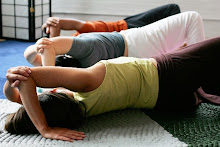
Self-acceptance is not rationalization, where you lie to yourself that your behavior is OK. Self-acceptance is the willingness to look at the truth and acknowledge it. It takes ongoing self-awareness to notice when the time is ripe for positive change, and when the way is blocked. Your Feldenkrais classes can be the foundation for new self-awareness, from the inside out. Feldenkrais classes "upgrade" the connection and communication between your brain and your body, using movement -- the native language of your entire nervous system.
You'll be amazed at what can change.
Sunday, January 3, 2010
New Year, New You
Thursday, November 19, 2009
We're on TV! High Heels Workshop
Watch our recent appearance on "Mirror, Mirror" with Rebecca Spera, as seen on ABC's LiveWell HD TV Network. Be sure to have your sound/earphones "on."
Now I know what shoes to buy! AND our next High Heels Workshop is December 6!
Click here for information and to register online.
Monday, October 19, 2009
Wise Words/DUH!
Image via Wikipedia
A story last week caught my eye, and I just had to share it. You can read it on The Onion here. But here's the main text of the article:
Study: Majority Of 'Calm Downs' Ineffective
October 12, 2009 | Issue 45•42
ITHACA, NY—A study published recently in the Journal Of Mental Health found that attempting to reverse a loud emotional display by asking an individual to calm down was effective only 9 percent of the time. Researchers at Cornell University's behavioral lab induced anxiety in subjects by administering a series of electric shocks, after which everyone was told to "calm down" and "take it easy." "We were surprised to find that not only were these phrases ineffective, but in an overwhelming number of cases they actually exacerbated the situation," psychologist Kenneth Pulaski said. "Even when participants were told to 'just take a deep breath,' they became more and more irate and were eventually reduced to a screaming mess." The study also concluded that telling someone to "just mellow out" would invariably lead to a researcher being punched in the face.
This is a wonderful finding, and thank goodness research has "proved" it, finally! Point noted. Check.
Have you also noticed that, as a professional brings your attention to your tight muscles or pain, they often tell you that you "just need to relax" or "stop holding" or "stop resisting?" It's the same thing, isn't it? The problem is, most people have FORGOTTEN how to "relax." If you knew how to do it, you'd be doing it, right?
There's another problem with this whole "relaxation" idea. Deep down, we know that the state of total relaxation you feel during a wonderful massage, or the momentary zombie-like feelings right after a Feldenkrais lesson, are not very useful, except perhaps for falling asleep! Our problem is that we have only two choices: either be a caffeinated, wound-up, stressed-out, Type-A maniac, or be an unconscious puddle of invertebrate goo somewhere on the floor. Most people realize, at some level, that total relaxation is not a real solution for navigating the demands of daily life.
There is good news, however. Just as you may have forgotten what easy, pain-free, effortless action (much better, distinct from "relaxation," wouldn't you say?) feels like, you can RE-LEARN those sensations and find some relief. That's where movement education, or re-education, is valuable, and that's what The Feldenkrais Method teaches. That's why I don't tell my clients to relax. Students of the Method re-learn the patterns of moving, feeling, and sensing that are part of our human birthright.
Moshe Feldenkrais wrote a fascinating book, entitled "The Elusive Obvious." In it, he explores an essential human folly: we find one good idea, and expect to apply it everywhere and from henceforth, with uniformly positive results. However, this is rarely the case. The book gets you thinking more deeply about your unconscious assumptions about yourself and the world around you. The idea of The Onion's made-up research study is one of those "elusively obvious" notions -- one you might not have thought of before, but leads to a dawning awareness.
Saturday, June 27, 2009
You Wanna Talk Fireworks?
If you want to experience REAL fireworks, watch what happens when you try to change someone's routine.
Ooooohhh, LORDY! Stand back! And, unlike those displays you'll watch at the park, on your porch, or on the television later this week, the "fireworks" I'm talking about can happen suddenly, without warning, at any old time. And, it can happen to people who supposedly have this whole change thing DOWN. It's all cool, right, whatever? (Begin Twilight Zone theme. . .) People like you and me can go, well, a little bonkers. Ladies and Gentlemen, please allow me to recount a tale of my recent experience, which will shock and amaze you. What sets off your fireworks?
For the past two years, I've taught a Feldenkrais Awareness Through Movement class each week at the MD Anderson Cancer Center's Place. . .of wellness. The POW (as "insiders" call it, strangely appropriate this week, it seems!) is a wonderful place where anyone whose life has been touched by cancer can take advantage of free programs designed to reduce stress and feed the body, mind, and spirit. Yoga, Quigong, Acupuncture, and Feldenkrais Method classes have been regular fixtures for many years in this ground-breaking "complementary and alternative" wellness-based approach to cancer care. The POW hosts patients currently undergoing treatment, families and caregivers, and members of the community at large. I am privileged to be there, and I enjoy a cordial relationship with the regular staff. I really look forward to teaching my class there each week. I look forward to the experience, even though I must deal with (dun dun DUNNNNN!) The Medical Center.
Say, "Medical Center" to anyone who lives in Houston, and you'll get an understanding eye roll, or perhaps a shudder. It's the renowned Texas Medical Center, the largest in the world. The traffic is atrocious. The parking is expensive. For many people, just dealing with the place once is enough to send them, terrified, on circuitious routes to avoid the area. Yet, each day, countless people drive there and park, to spend an hour or the entire day dealing somehow with the realities of cancer. I used to become very impatient each week as I pulled into Garage 10, the one closest to POW. One day, I realized that the drivers were doing the best they could. They, or a loved one, are probably a patient, completely preoccupied with a serious life-crisis. Driving, Schmiving. It's the last thing on their mind. I've learned to chill out, breathe, and plan to spend extra time in the garage to make it to my class on time. However, I'd be fibbing if I told you I wasn't a little stressed out by my trips to the Medical Center.
So, last week, progress came to the Medical Center. The entire method of paying for parking has changed. You used to drive into the garage, push a button on the gate, and the machine would spit out a paper ticket with a magnetic strip. You had to take the ticket with you -- o god don't leave it in the car -- and later validate it and pay via a large machine in the lobby of the garage. Although I only mangled my ticket a couple of times, I learned the system, and even learned to joke about it with other sufferers. The kiosk's robotic voice sounded a lot like Stephen Hawking ("Your parking fee is Six Dollars. Please pay. With cash. Or Credit. Card."), which amused me, and I rather looked forward to talking to Stephen on my visits to the garage. Was he living in Houston now, inside that box? Or were we talking on the speakerphone? Whatever. Stephen and I had our thing. However, last Thursday, EVERYTHING changed. Or so it seemed.
I drove in the entrance, and the gate was different. I pushed the button, a new button, and a yellow plastic disc was dispensed instead of a ticket. What the hell? I put the token in my pocket, a bit shaken, but noticing the advantage of the non-mangling. When I was ready to leave, I inserted the token into a new machine. Although I was relieved that the experience of paying was about the same (the same slots were available for cash or credit cards), I quickly became rattled. Stephen Hawking was GONE! Did Stephen get fired? All that we had was now finished, just like that. Some new young guy is now in the machine. Oh, well.
Attendants were stationed in the garage lobby, and at the exit gate ("Just insert the token, Ma'am.") to help anyone who was on the verge of flipping out. I had to breathe. And I realized how I, even I, a helper of people who are in the midst of navigating change, was using my sense of humor to deal with a disruption of a routine I didn't even realize I had. Others were not able to access their sense of humor. They were perturbed. Some, explosively so. Apparently, we all attach to our routines. We notice when we must change.
The lesson is, a little perturbation is necessary in life to move us forward, and to help us to adapt to a changing environment. I'm glad I have my training in the Feldenkrais Method to help me play with change, discover possibilities, and enjoy my expanding capacities to do new things. Who knows? That new guy in the machine might be really nice.
Improve Balance with the FELDENKRAIS METHOD
Image via Wikipedia
Although it's not light reading, the introduction to the study provides a clear description of the Feldenkrais Method, and how it helps people to improve their functioning in balance. Your motor skills, usually the focus of traditional therapies, are improved by improved sensory awareness. The Feldenkrais Method specifically improves the kinesthetic sense (awareness of HOW you move) and overall coordination, which are NOT usually included in a comprehensive way in traditional therapies.
To quote briefly from the study: "Twenty-six participants in the treatment group engaged in twice-weekly Feldenkrais classes that were specifically tailored to address balance issues. The combination of exercises was named "Getting Grounded Gracefully," and lasted a total of 10 weeks. An "activities specific" questionnaire, a physical test known as the Four Square Step Test (FSST), and "self-selected gait speed" (walking speed) were assessed before and after the trial."
The results? "All measures of balance and mobility were improved in the Feldenkrais treatment group. In addition, most of the active participants noted benefits with regard to body image and a greater ability to engage in everyday activities, such as walking pets and climbing slopes." (Healthy Fellow)
While the new study dealt with older adults experiencing difficulties with balance, there's another perspective on balance from the world of fashion. Coming soon to a city near you: "How to Walk in High Heels using the Feldenkrais Method." You'll learn how to walk in high heels with safety and comfort. Here's a video story from Good Morning America about one such workshop in New York City. (Click to play.) Houston, Texas holds a High Heels workshop coming to the NiaMoves Studio in the Heights on July 18. Click here to register.
The sense of balance is perhaps our most essential sense. Anyone, young or old, can improve balance with the Feldenkrais Method.
Monday, June 15, 2009
Strong Back, Comfortable Arms, Hands Skillful and Free: the Paul Rubin Houston Workshop
Paul Rubin, one of the original U.S. students of Moshe Feldenkrais, presented a workshop at NiaMoves in the Heights (Houston, TX) June 6-7. Twenty-one people attended, and the experience was transformational. Here are some of the responses to the workshop.
"I found the workshop interesting, fascinating and enlightening. . . When I got on my computer Saturday evening, I noticed that I was using my whole arm to move the mouse versus just the wrist. That was astonishing. At the office on Monday, I noticed that my whole arm was moving when I was mousing. The lesson was still hanging on. I enjoyed meeting and listening to Paul. Quite the storyteller and hugely interesting. Thanks for providing the opportunity to attend the class."
"It has been an unusual week after the workshop. I . . . thought I was prepared for the weekend activities --but was most surprised. The gentleness and subtleness of Feldenkrais is deceiving. It is very powerful work and has taken me several days this week to begin to process all that changed and I feel that I have just begun. The most significant thing I noticed is how much emotional baggage I carried in my body and that continues to release. . . ."
"I'm so appreciative that you brought Paul Rubin to Houston and that I've gotten to know him and work with him. Those two days were amazing in so many ways. First, I found myself feeling like a kindergartener again working on the floor mats. Being on the floor brought me back to a "nap time" remembrance of Kindergarten and how I was learning new things about the world, only this time I was learning about my body. The whole time was such a good mix of thinking self awareness and feeling awareness. It's hard to describe exactly, what changes have taken place. I know I have a much greater appreciation and self awareness of how I move in space and sensing my movement originating from my core, and also having a curiosity to see how my body does things. "
"There were many, many things I enjoyed about the day and ½ and how Paul Rubin teachesI think ….that I observed a brilliant method of providing opportunity to “anticipate” a movement “fill in the blank” with one’s own ideas too. . . >The weekend workshop has been on my mind frequently. Thank you very much. Here are my thoughts and observations. I have slept better since. ">When I put on my earrings Monday morning….I noticed that my right ear was higher than my left ear. Yes! I thought that I had “lifted” my right side out of my back and shoulder in the last set of movements on Sunday.I did a day of physical work on Monday…down and dirty…polishing the floors in my old house, which I do by hand and on my knees. I was able to be more aware of fatigue and tension and move in such a way that there is no pain.But more than that…..The thinking that Paul Rubin presented is so consistent with what I understand to be “a systems view of the body (including brain)”. And he put in words observations I still struggle to articulate. Which means I understood more deeply myself after the workshop. He has clearly integrated experience and science in a way that is very helpful."
"Thank you for organizing this workshop. You and Paul are wonderful teachers and now I have a little better sense about ATM and its benefits. My impressions during the workshop were more experiential than anything and a little difficult to describe in words. Enjoying the exploration of what felt comfortable and what didn’t during the lessons was very interesting. Also, noticing how my parts fit together (i.e. hand into arm into shoulder)"I had a dream early Monday morning that I was dancing an Irish jig! Very funny initially, but I was REALLY good -- LOL!!! In the reverie before I woke up, I had a visual of using my hands to go through the stacks of work on my desk. My visual also including prioritizing the work so that I was only dealing with the most critical issues first. Needless to say, Monday and today have been extremely productive for me."
Did you miss it? Paul will return to Houston in September. Dates will be announced soon. Be there, or, as they say. . .
Old Dogs, New Tricks
When was the last time you learned something new?
Now, stop for a moment. When you think about answering that question, do you feel 1) excited and eager to share, or 2) bewildered, searching to remember, or 3) clenched, thinking, "Enough with the learning already!" ?
Learning has taken a bad rap. I think this is because we think of "Learning" as something we have to do for a set period of time, as in the school years, during a university degree, or a formal class. The most highly valued evidence that this type of learning has been successful is performance on a standardized test. Somehow our culture sets us up to expect that one day we'll be done learning, and then will go do something real, or practical. Learning has been taken over by professionals whose emphasis is on teaching, or content delivery. Teaching in our schools, and the vast majority of inservice or corporate training programs are woefully one-sided and delivery-oriented. All too few are concerned whether the "target" (student) actually received, assimilated, and is using -- learned -- the content. I've been intrigued with this distinction between teaching and learning since I first read Carl Rogers' Freedom to Learn in the early 1970's. But I digress. . .
Rogers says, in part, that nobody can teach another person anything. All they can do is create the conditions so that the individual can learn for themselves. Think of the "force feeding" you may have experienced with your worst "educational experience." Contrast that with the joy, sense of accomplishment, vitality, and total absorption you have felt when you are truly engaged with something new that interests you. This is learning, true learning, and it can go on throughout your life. The evidence that this kind of learning has occurred is that behavior changes. You are doing something new, or doing something old in a new way.
This past weekend, I attended an event called PodCampHouston. Based on the BarCamp model, PodCampHouston attracted people who were interested in learning more about online media, or "new media;" specifically podcasts and video blogging. This was my second experience with the Camp idea, and it's unlike any workshop or conference I've ever experienced. In fact, it is promoted as an "un-conference," or more accurately, a "user-generated" conference. Each participant is encouraged to make a presentation! A white-board in the entry hall is marked with a grid, times on one axis and room availability on the other. You sign up for a time, announce your topic, and then people "vote with their feet" when the time comes.
Well, I took the plunge and signed up to present. Several people had expressed interest in my vocal coaching and movement work, so I thought I could probably riff for awhile on "You and Your Voice" for these budding broadcaster/podcasters. What a blast! Twenty-five people showed up, asked questions, and the room filled with animated conversation, connection, and laughter.
Moshe Feldenkrais said that anything you learn that stays with you in a profound and positive way was learned when you were having fun. At PodCampHouston, we met as friends and colleagues in an atmosphere of fun and mutual respect. We learned from each other, shared, and grew in the process.
I have two core beliefs that regularly pop up into consciousness. 1) You can do anything if you don't know how, and 2) Anything worth doing is worth doing badly. Remember what I said about learning changing behavior? Well, Sunday afternoon, I sat down at my computer and made my first video podcast series! It's called "You and Your Voice: Do I Sound OK?" and is taken from my presentation at PodCamp Houston. As with any new ventures, it's a first approximation. I don't have a fancy set or makeup artist. The six, 10-minute segments are basically just my talking head. However, I created some content, shared it, and I'll get better as I continue to learn more. Yes, it's a little scary to put myself out there. Yes, there will be criticism at all levels. Oh well. It was fun. I learned something. I'll do it again. So there.
Madeleine L'Engle wrote a book called "Walking On Water" about the creative process. She uses the metaphor of a vast and beautiful lake to represent the sum of all creative work -- every symphony, novel, play, invention, everything. She says you can't hold yourself to the standard of creating a St. Matthew Passion each time you begin your creative work. Your only job is to "feed the lake." Contribute something, even a trickle, from your small stream of creativity, no matter what it is. Accept, and feel satisfied, with that. You and your abilities will improve over time as you continue to "feed the lake." I love this image.
The Feldenkrais Method is a great way to jump-start your love of learning (real learning) and your creativity. It uses your own body, your attention, and gentle movement as the vehicle for developing awareness, fluidity in thought and action, and a sense of infectious curiosity. If this old dog can learn new tricks, so can you!