Showing posts with label Houston. Show all posts

Monday, October 5, 2009

Making Sense of Life

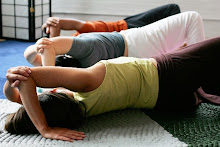
Feldenkrais Awareness Through Movement(R) lessonImage by divamover via Flickr

Life is interesting.

Through good times and bad, great joys and great sorrows, all we can do is make the best sense of it we can.

It is this "making sense" that so intrigues me, and to which I have devoted my life and work. It seems that we have all learned to separate what is going on in our thinking processes (logic, linear progressions, judgments, or imaginations) from what is going on in our bodies. Most people (especially Baby-Boomers, newly perceiving themselves -- ourselves -- in decline) come to see their body as a maintenance problem, constantly to be exercised, strengthened, stretched, moisturized, conditioned, fueled, satisfied, and monitored for signs of impending doom. Everything that goes in or comes out of our bodies is scrutinized, and we actually FEEL very little of what goes on. How much obesity occurs because the person cannot feel the sensation of fullness, or satisfaction? How many injuries occur because painful warning sensations are ignored? My continuing fascination with the Feldenkrais Method usually comes back to the interplay within the system of moving, thinking, feeling, and sensing. Improving our sensitivity to our senses can help us to "make sense" of the world around and within us.

Here follow three stories of people "making sense."

Divergence Vocal Theater presented their third artistic collaboration and multi-inter-extra-disciplinary production this past weekend. Their performances defy description; even their self-proclaimed status as "Houston's renegade, indie opera company" doesn't do it justice. Artistic Director and Founder Misha Penton embraces her vision to let more and more of the experience evolve for her performers and her audience. The evening was a mix of contemporary vocal and instrumental music (harp, sitar, and piano), spoken word, modern dance, and stunning visuals created through lighting, film, and long diaphanous strips of colored fabric. The fabrics, in warm oranges, taupes, and sages, stretched the length and breadth of the performing space, on the stage and in the audience; constantly changing, weaving, carried, carressed, abandoned by the performers. The entire evening, around the theme "Autumn Spectre," was one of achingly beautiful sensory demand. The performance defied all traditional expectations of making sense, if you needed a story line, characters, conflict, or moral. However, sense was made in the way love is made, one delicious sensation at a time. Each person made their own sense. Even seated in the space, all were moved.

***

The little girl is four years old. She is bright, funny, cheerful, and beautiful, and every day is a struggle. Because of a rare anatomical defect in her brain, she has not yet sat up by herself, crawled, or supported her weight to walk. With gentle playfulness, we access her own deep knowing of how to move. We explore the human developmental sequence, picking up at about 6 months of age, where the limits of her brain structure reached and then sort of stalled. With each movement, lifting the head, or tucking the chin, or bringing knees up over her belly to roll back and forth, her brain is making new connections, finding "ways around." Her sensations give her input on which to build toward the next part of the sequence. She rolls over onto her tummy much more easily and readily. It's a thrill to see her roll her pelvis then so that one knee can begin to bend and come up alongside, then under her. Her family and I are banking on neuroplasticity -- the ability of the brain to change, grow, and adapt to useful input -- and we are seeing progress. We are all making sense -- discovering it, sensation by sensation -- the best way we can. Who knows where it will lead?

***
It's a lovely fall Friday evening in Houston, and happy hour is underway. Self-identified geeks -- a mix of web and software designers, programmers, photographers, and other technophiles get together for beverages and conversation at our favorite Midtown watering hole, The Coffee Groundz. Another group intermingles with them -- people who get together quarterly with the sole purpose of socializing while wearing tiaras. The Venn Diagram of the two groups has a surprisingly large overlapping center. Frivolity reigns. There's nothing like a group of people together relaxing and having a good time. One can sense that these people work hard. They play with great dedication. They'll go forth to conquer the world again on Monday.

***

Take a breath, try something new. Use your powers for good. By feeling your way, you're bound to make sense of some of it.
Reblog this post [with Zemanta]

Stumble Upon Toolbar

Sunday, July 12, 2009

Local, Global, Local


Each Feldenkrais lesson begins with an invitation to notice something. This noticing is gradually directed toward the observation of curious details about the way you move, rest, and solve minor problems. A movement that feels isolated, strange, and difficult quickly reveals itself to be easy, graceful, and that your whole self is involved. You learn a process of learning and exploration that can be applied in any setting. After awhile, most people report that the effects of the lessons have begun to generalize -- to "show up" as improvements in unexpected places, like their relationships, their work, their outlook. What began exclusively as a personal exploration of a specific issue eventually affects the world around you.

This ability to change your viewpoint, from local to global, or self to environment, and back again, is a crucial skill. Without it, you literally cannot move. A changing perspective gives a more complete view, and yields the opportunity to take intelligent action. Individual actions make a difference. Last week, I saw several examples of this, "on the ground."

One client, a zippy octegenarian, has a new lease on life. After two surgeries on the same shoulder and a slow recovery, she was discouraged with her lack of progress. After 14 months and several courses of frustrating and painful therapy, she still could not drive without pain, lift her arm overhead, or dress herself normally. After a little more than a month of Feldenkrais lessons, she has regained most of her range of motion, and can now drive and do household tasks without pain. She learned that her shoulder is connected to the rest of HER, and that when her whole self is involved in movement, her shoulder moves more easily. She has regained her independence and is now eager to get back to her social life. Another client, having survived a brain aneurism, still walks haltingly and has difficulties with balance. Our first lesson helped her to sense her ankles as she walked. She reported that later in the day, a friend told her she seemed to be moving better and with more stability. She was thrilled! One solution involved viewing the problem in a larger context; the other solution involved a seemingly minor detail that was an essential part of the whole. Both perspectives are needed for a fresh outlook and a new beginning. As Moshe Feldenkrais said, "The possibility of improvement is limitless." The cumulative effect of many small actions can lead to a big result.

Here's another story. Houstonians Ernie and Sheryl Rapp thought that our city should host its own version of the TED Conference, bringing the top creative minds to Houston to speak from their unique perspectives. They founded and launched The UP Experience ("Like TED, Only Hotter) in 2008. A second event is planned for October 15, 2009. Home-grown initiative and actions have resulted in an event of international caliber and influence. Through Ernie and Sheryl's creativity and dedication, locals will get a global perspective we wouldn't have had otherwise.

In another example, some Houston entrepreneurs, artists, and musicians have begun an initiative called "Support Local/Grow Together." It's a simple idea, really, do to business in your own community, with people you know, like, and trust. SLGT adds a personal, word-of-mouth, nice-to-know-you dimension to the buying decisions you make every day. Hang out at your local coffee shop, independent book store, or neighborhood mom-and-pop restaurant. Recommend your hairdresser, doctor, computer genius, or designer to your friends. You could purchase some fabulous vegetables at a farmer's market, get your printing done at a local shop, collect pieces by a Houston artist, seek out Houston musicians and performers for your next party. Attend a local conference, sample a new wine, follow your curiosity into new plans for self-development! (I recommend the Feldenkrais Method.) Again, the cumulative effect of many small actions can lead to a big result.

If you live elsewhere, you can begin to promote SLGT wherever you are. The "top down," big solutions to our economic woes are only part of the picture. SLGT is grass-roots, right in your own backyard. Global and local perspectives are points on a spectrum, and we must continually navigate between them. Individual actions, chosen with awareness and intelligence, will always make a difference.

You can become a fan of SLGT: Support Local/Grow Together on Facebook.


Reblog this post [with Zemanta]

Stumble Upon Toolbar

Monday, July 6, 2009

The 100-Degree Rule

Wortham Foundation GardensImage via Wikipedia

(Translation for our international readers: The 38-Degree Rule. Celsius. Right.)

We can't help ourselves, talking about the weather. The 100-degree Rule is: if it's 100 degrees outside (or more), stay inside!

Houston has endured weeks of record-breaking temperatures. And it's a damp heat, mostly. Day after day with the thermometer reading in triple digits begins to wear. People feel cranky. We have the summer version of "cabin fever."

Amid lots of great entertainment options last week, leading up to the Independence Day holiday, we passed on all of them. Ordinarily, an evening out at Discovery Green would be delightful. Dining al fresco at our favorite spot in Midtown is usually a treat. However, we invoked the "100-degree rule" and watched the celebratory fireworks on television, in air-conditioned comfort. It's a matter of self-preservation. At its root, this is an issue of respect. You have to respect the heat. And, you have to respect yourself.

Luckily, most people do take care of themselves under these extreme conditions. The heat assaults you as you open the front door, nagging and nagging you to pay attention. Stay cool, dress lightly, protect from the sun's rays, keep well hydrated. However, most people won't take care of themselves on a daily basis, or in the absence of emergency conditions. We don't view self-care in terms of sustainability.

If only we had more personal "100-degree rules," individual barometers to gauge when "enough is enough." More respect for self might lead to more respect for the messages of pain, of satiety, of anxiety. The heat is like a 2x4 upside the head. You have to be listening and all senses "tuned up" to appreciate more subtle and habitual sensations. The 100-degree rule is simply an invitation to pay attention.

The Feldenkrais Method is remarkable for its respect of individuals and the circumstances in which they find themselves. The work leads inevitably to deeper explorations of self-reliance, self-sufficiency, and independence. You could even say that people find freedom here. However, these are not empty platitudes or tenets of an ideology. They are the building blocks for intelligent, cooperative action, within oneself and within society. The Method values your senses and sensations as first-line sources of information about your body, your safety, and your environment. Any action is only as effective as the sensitivity to initial conditions.

Pop-up thundershowers throughout the coming week will bring some relief. A visit to a Feldenkrais class (all air-conditioned!) brings a similar refreshment. Have your own personal independence day. New ideas, actions, and possibilities abound. Let freedom ring!

Reblog this post [with Zemanta]

Stumble Upon Toolbar

Saturday, June 27, 2009

Improve Balance with the FELDENKRAIS METHOD

The feet of a tightrope walker.Image via Wikipedia

Last week, an exciting new study was published: "Feldenkrais Method® Balance Classes Improve Balance in Older Adults: A Controlled Trial."

Although it's not light reading, the introduction to the study provides a clear description of the Feldenkrais Method, and how it helps people to improve their functioning in balance. Your motor skills, usually the focus of traditional therapies, are improved by improved sensory awareness. The Feldenkrais Method specifically improves the kinesthetic sense (awareness of HOW you move) and overall coordination, which are NOT usually included in a comprehensive way in traditional therapies.

To quote briefly from the study: "Twenty-six participants in the treatment group engaged in twice-weekly Feldenkrais classes that were specifically tailored to address balance issues. The combination of exercises was named "Getting Grounded Gracefully," and lasted a total of 10 weeks. An "activities specific" questionnaire, a physical test known as the Four Square Step Test (FSST), and "self-selected gait speed" (walking speed) were assessed before and after the trial."

The results? "All measures of balance and mobility were improved in the Feldenkrais treatment group. In addition, most of the active participants noted benefits with regard to body image and a greater ability to engage in everyday activities, such as walking pets and climbing slopes." (Healthy Fellow)

While the new study dealt with older adults experiencing difficulties with balance, there's another perspective on balance from the world of fashion. Coming soon to a city near you: "How to Walk in High Heels using the Feldenkrais Method." You'll learn how to walk in high heels with safety and comfort. Here's a video story from Good Morning America about one such workshop in New York City. (Click to play.) Houston, Texas holds a High Heels workshop coming to the NiaMoves Studio in the Heights on July 18. Click here to register.

The sense of balance is perhaps our most essential sense. Anyone, young or old, can improve balance with the Feldenkrais Method.

Reblog this post [with Zemanta]

Stumble Upon Toolbar

Monday, June 15, 2009

Strong Back, Comfortable Arms, Hands Skillful and Free: the Paul Rubin Houston Workshop

Paul Rubin, one of the original U.S. students of Moshe Feldenkrais, presented a workshop at NiaMoves in the Heights (Houston, TX) June 6-7. Twenty-one people attended, and the experience was transformational. Here are some of the responses to the workshop.

"I found the workshop interesting, fascinating and enlightening. . . When I got on my computer Saturday evening, I noticed that I was using my whole arm to move the mouse versus just the wrist. That was astonishing. At the office on Monday, I noticed that my whole arm was moving when I was mousing. The lesson was still hanging on. I enjoyed meeting and listening to Paul. Quite the storyteller and hugely interesting. Thanks for providing the opportunity to attend the class."

"It has been an unusual week after the workshop. I . . . thought I was prepared for the weekend activities --but was most surprised. The gentleness and subtleness of Feldenkrais is deceiving. It is very powerful work and has taken me several days this week to begin to process all that changed and I feel that I have just begun. The most significant thing I noticed is how much emotional baggage I carried in my body and that continues to release. . . ."

"I'm so appreciative that you brought Paul Rubin to Houston and that I've gotten to know him and work with him. Those two days were amazing in so many ways. First, I found myself feeling like a kindergartener again working on the floor mats. Being on the floor brought me back to a "nap time" remembrance of Kindergarten and how I was learning new things about the world, only this time I was learning about my body. The whole time was such a good mix of thinking self awareness and feeling awareness. It's hard to describe exactly, what changes have taken place. I know I have a much greater appreciation and self awareness of how I move in space and sensing my movement originating from my core, and also having a curiosity to see how my body does things. "

"There were many, many things I enjoyed about the day and ½ and how Paul Rubin teachesI think ….that I observed a brilliant method of providing opportunity to “anticipate” a movement “fill in the blank” with one’s own ideas too. . . >The weekend workshop has been on my mind frequently. Thank you very much. Here are my thoughts and observations. I have slept better since. ">When I put on my earrings Monday morning….I noticed that my right ear was higher than my left ear. Yes! I thought that I had “lifted” my right side out of my back and shoulder in the last set of movements on Sunday.I did a day of physical work on Monday…down and dirty…polishing the floors in my old house, which I do by hand and on my knees. I was able to be more aware of fatigue and tension and move in such a way that there is no pain.But more than that…..The thinking that Paul Rubin presented is so consistent with what I understand to be “a systems view of the body (including brain)”. And he put in words observations I still struggle to articulate. Which means I understood more deeply myself after the workshop. He has clearly integrated experience and science in a way that is very helpful."

"Thank you for organizing this workshop. You and Paul are wonderful teachers and now I have a little better sense about ATM and its benefits. My impressions during the workshop were more experiential than anything and a little difficult to describe in words. Enjoying the exploration of what felt comfortable and what didn’t during the lessons was very interesting. Also, noticing how my parts fit together (i.e. hand into arm into shoulder)"I had a dream early Monday morning that I was dancing an Irish jig! Very funny initially, but I was REALLY good -- LOL!!! In the reverie before I woke up, I had a visual of using my hands to go through the stacks of work on my desk. My visual also including prioritizing the work so that I was only dealing with the most critical issues first. Needless to say, Monday and today have been extremely productive for me."

Did you miss it? Paul will return to Houston in September. Dates will be announced soon. Be there, or, as they say. . .

Stumble Upon Toolbar