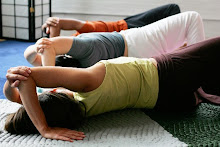
Each Feldenkrais lesson begins with an invitation to notice something. This noticing is gradually directed toward the observation of curious details about the way you move, rest, and solve minor problems. A movement that feels isolated, strange, and difficult quickly reveals itself to be easy, graceful, and that your whole self is involved. You learn a process of learning and exploration that can be applied in any setting. After awhile, most people report that the effects of the lessons have begun to generalize -- to "show up" as improvements in unexpected places, like their relationships, their work, their outlook. What began exclusively as a personal exploration of a specific issue eventually affects the world around you.
This ability to change your viewpoint, from local to global, or self to environment, and back again, is a crucial skill. Without it, you literally cannot move. A changing perspective gives a more complete view, and yields the opportunity to take intelligent action. Individual actions make a difference. Last week, I saw several examples of this, "on the ground."
One client, a zippy octegenarian, has a new lease on life. After two surgeries on the same shoulder and a slow recovery, she was discouraged with her lack of progress. After 14 months and several courses of frustrating and painful therapy, she still could not drive without pain, lift her arm overhead, or dress herself normally. After a little more than a month of Feldenkrais lessons, she has regained most of her range of motion, and can now drive and do household tasks without pain. She learned that her shoulder is connected to the rest of HER, and that when her whole self is involved in movement, her shoulder moves more easily. She has regained her independence and is now eager to get back to her social life. Another client, having survived a brain aneurism, still walks haltingly and has difficulties with balance. Our first lesson helped her to sense her ankles as she walked. She reported that later in the day, a friend told her she seemed to be moving better and with more stability. She was thrilled! One solution involved viewing the problem in a larger context; the other solution involved a seemingly minor detail that was an essential part of the whole. Both perspectives are needed for a fresh outlook and a new beginning. As Moshe Feldenkrais said, "The possibility of improvement is limitless." The cumulative effect of many small actions can lead to a big result.
Here's another story. Houstonians Ernie and Sheryl Rapp thought that our city should host its own version of the TED Conference, bringing the top creative minds to Houston to speak from their unique perspectives. They founded and launched The UP Experience ("Like TED, Only Hotter) in 2008. A second event is planned for October 15, 2009. Home-grown initiative and actions have resulted in an event of international caliber and influence. Through Ernie and Sheryl's creativity and dedication, locals will get a global perspective we wouldn't have had otherwise.
In another example, some Houston entrepreneurs, artists, and musicians have begun an initiative called "Support Local/Grow Together." It's a simple idea, really, do to business in your own community, with people you know, like, and trust. SLGT adds a personal, word-of-mouth, nice-to-know-you dimension to the buying decisions you make every day. Hang out at your local coffee shop, independent book store, or neighborhood mom-and-pop restaurant. Recommend your hairdresser, doctor, computer genius, or designer to your friends. You could purchase some fabulous vegetables at a farmer's market, get your printing done at a local shop, collect pieces by a Houston artist, seek out Houston musicians and performers for your next party. Attend a local conference, sample a new wine, follow your curiosity into new plans for self-development! (I recommend the Feldenkrais Method.) Again, the cumulative effect of many small actions can lead to a big result.
If you live elsewhere, you can begin to promote SLGT wherever you are. The "top down," big solutions to our economic woes are only part of the picture. SLGT is grass-roots, right in your own backyard. Global and local perspectives are points on a spectrum, and we must continually navigate between them. Individual actions, chosen with awareness and intelligence, will always make a difference.
You can become a fan of SLGT: Support Local/Grow Together on Facebook.
Sunday, July 12, 2009
Local, Global, Local
Tuesday, May 26, 2009
Holiday Weekend Recovery
Image by K. Todd Storch via Flickr
It's the aftermath of something wonderful: the extended Memorial Day weekend. Most people I know packed as much flag-waving, barbeque-eating, beer-drinking, and all-out week-ending as was humanly possible. Add in your own favorite hypenated pastime: mine this weekend included Law-and-Order-marathon-watching and week-ahead-meal-preparation. Yours might be bike-riding, game-playing, kid-enjoying, tube-floating, wedding-attending, house-cleaning, or mega-shopping. You get the idea. When we have a long weekend, we do it up BIG. And today, Tuesday morning, for some of us, feels like -- a HANGOVER.
I watched the Twitter stream for awhile this morning, as "Memorial Day" was still a trending topic. One person, @chadwicknorris, said
It's almost 10 am and I'm still trying to get motivated. I call it "The Memorial Day Weekend effect".
We leave work, feeling exhausted, and eagerly anticipating the extended weekend. We return to work, stil exhausted. What's wrong with this picture? Why do we do this to ourselves?
I suspect that one aspect is an almost universal and unconscious belief that we "should" be like the Energizer Bunny. "He keeps going, and going, and going. . ." We expect nothing less of ourselves. Our idealization of heroes has become pathological: we revere the person who is least like, well, a person. At least superheroes have superpowers! We expect ourselves, without superpowers, to work relentlessly at peak performance, requiring nothing in the way of rest or routine maintenance. We are no longer satisfied with being "superhuman." We now aspire to be like a super machine. And, when or if we are injured, we see no alternative but the scrap-heap. The imperfect machine gets traded for an upgrade. No wonder we are terrified to stop, even for a moment.
We kill the pain with more activity, more relentlessness. We can't tell when we've had enough. Hell, we'll never admit we've had enough. That's the formula for a hangover.
The best antidote here is an ounce of prevention. Season the recipe of your life with some good, old-fashioned PLAY. Play is the ingredient that refreshes, renews, and re-energizes your life and your perspective. Re-discovering your ability to play can be the key to finding a more creative, innovative, imaginative, resiliant YOU. Most people have forgotten how to be playful.
The Feldenkrais Method can re-connect you with your innate abilities to move, sense, think, feel, and PLAY. Remember those long summer days as a kid, when you happily lost track of time, engrossed in whatever you had discovered? Like that. During a one-hour Awareness Through Movement lesson, your curiosity is tickled. You are invited to explore and experiment. How will it turn out? We don't know. But we know you will feel safe and comfortable during the process. And we know you will feel DIFFERENT afterwards. People take this playful stance back to work with them, back home to their families, back into their daily activities. The fresh approach, the awareness, the courage to play helps them to reap dividends in the present moment as well as the future.
Stuart Brown, MD, is one of the leading researchers on the neuroscience of play. He says that the opposite of play is not work, but rather, depression. He argues that work at its best can FEEL like play: absorbing, enlivening, experimental, improvisatory, satisfying, time-expanding fun! Play has many beneficial after-effects, unlike the hangover of the Memorial Day Effect. You are in the present moment, happy to be where you are, and refreshed for the day's tasks.
It's summertime! Come and play with us!
Wednesday, March 18, 2009
The UP Experience Blog
I'm lucky to be one of the writers for the blog for The UP Experience. Here's a new post that speaks to some themes of the Feldenkrais Method:
Steve Wozniak started ballroom dancing five weeks ago. He’s had two weeks of competition. He is a beginner, and he is a fast learner. Having made some footwork mistakes on Monday night, he analyzed the problem, perceived the pattern, and was able to correct it. The studio audience gave him a standing ovation, and Twitter went wild. Dancers and audience members alike learn, over the course of the season, to make ever finer distinctions. Even though the back-stories can be a little cheesy and often seem like unnecessary padding in the bloated show, they allow us to witness the personal growth of the contestants. Real growth and development. That’s extraordinary, especially in prime time. Everyone learns, and the American Public learns to appreciate the process and the plain old hard work behind the scenes that leads to excellence and ultimately, to the best possible performance. Who knew that Dancing With The Stars would demonstrate — DEPTH?MaryBeth Smith, The UP Experience Blog, March 2009
Please read the whole article. I'm very interested in your comments, either here or there.
Sunday, December 14, 2008
Less, and More

One of the recent additions to my work and play life is an online social media site called "twitter." The site and its associated culture are a phenomenon, hot and getting hotter. As a participant, aka "twitterer," you agree to an interesting constraint: all posts to update the status statement, "What are you doing?" must be 140 keystrokes or less. To give you an idea what that is, if this paragraph were a twitter update, it would have stopped after the word "culture" in the second sentence. (Actually, that's 138 keystrokes.) You see the challenge?
Yet despite this constraint, millions of people worldwide now twitter. Within the 140-keystroke limit, known as a "tweet," twitterers share business and personal resources, music, movie and restaurant reviews, publicize upcoming events, comment on the news, ask and respond to questions, compliment and acknowledge their friends, and offer support in trying times. I've been amazed at the creativity and humor that are able to flower under this constraint, and at how large my world is becoming, getting to know people 140 keystrokes at a time. Twitter is growing because of this limitation, not in spite of it.
You can't help but notice: in 140 keystrokes, you have to make your point quickly. You don't waste strokes on unneeded spaces or redundancy. You use short words and abbreviations. You don't try to say everything you know about a subject. Now that it's the holidays, I've had an amusing cocktail party fantasy: cornered by the creepy office guy or the inappropriate sales pitch, escape is just 140 keystrokes away. THAT could be a wonderful world. . .
You don't need to worry: the tweet will not replace the doctoral dissertation, nor the great novel. Moshe Feldenkrais often showed how behaviors that are useful in one situation are not necessarily useful in every situation. Twitterers realize this fully. Each tweet is an introduction, a curiosity-inducer, and an invitation to sample more in another format, like a someone's blog or another website of interest. Feldenkrais based his work in movement and human development around the exploration of constraints, and the power of SMALL actions. (You can click here to download some short examples in audio mp3 format.)
I've learned through exploring constraints via the Feldenkrais Method, that a constraint is neither good, nor bad: it just IS. Now what will you do? Your habitual pattern of action probably won't work under the new conditions. What else could you do? Is there another way? Slowly, easily, gently, humorously, a little bit at a time, something new, interesting, and useful emerges. A new possibility is created.
I think both twitter and the Feldenkrais Method have a lot to offer us now, in what many acknowledge to be difficult times. A constraint can be a limitation, but only if you struggle against it and keep doing what you've always done. Small changes, added incrementally, mindfully, yet lightly, can make a huge difference. In problem-solving, you might be tempted to spend your energy on removing the constraint. This may or may not be possible. A more interesting solution is to work with the constraint, embrace it, and let imagination and experimentation reveal new possibilities.
If you take the long view, life itself is a "tweet." We have one life, or one life right now, depending on your viewpoint. If it's just going to be 140 keystrokes, how do you want to spend them?
Follow MaryBeth on twitter: http://twitter.com/divamover