The most-often asked question around Houston in the past two weeks has been, "Do you have lights yet?" Utility workers from across the country have come to Houston to help out, and they are being greeted with a hero's welcome. They are still working, now seventeen days after the storm.
"Having lights" is one of those things we won't take for granted again for awhile. It's really amazing, when you think of it-- that light should be available, at any time you want, for as long as you want, simply by flipping a switch! A light to read by, to see yourself in the mirror, to keep the steps safe. "Having lights" means even more: the refrigerator runs so you can make your own ice. The air-conditioner makes living in a swampy climate possible. The computer links you to the rest of the world, and you're back in business. It's said that the dying words of the German poet Goethe were, "Light, more light!" All of Houston would answer, "Amen!"
Chris and I only had to endure four days without power. We joined Richard and Elaine upstairs for breakfast each morning. We contributed the coffee beans and French press; they boiled water on the gas grill, and they had a hand-grinder which held together the civilized world for us. We'd get together again at dinner, to share news of what we'd seen and heard around the apartment complex and the neighborhood. Richard was the Grillmeister. Elaine and I planned menus based on strategic consumption of rapidly-thawing items from the freezer, accompanied by whatever fresh fruits and vegetables we had on hand. We wined and dined by candlelight far into the night, probably about 9 PM, to repeat the next day. The four of us celebrated our re-electrification, the first Tuesday after the storm, with a bottle of Prosecco, immensely grateful and relieved.
In the large scheme of things, four days without power is simply an inconvenience, not a catastrophe. However, many have been without power for over two weeks, and some without their homes, or food, or loved ones. So if you want to help, please give to the Red Cross or Gulf Coast Relief Fund.
The day our power came back on, I left on a business trip to San Francisco, where I lived in luxury with lights and computers and cool weather for nearly a week. I'll never forget the experience of flying back into Houston on Sunday evening, the 21st. It was getting close to 8 p.m., and the sun was rapidly sinking. I looked out the window to orient myself to familiar landmarks, and thought we must still be quite a ways out, because there were no city lights. From the air, Houston usually looks like a glittering blanket that stretches as far as you can see. The landscape gradually emerged: small, concentrated areas where the lights twinkled merrily, surrounded by total darkness. It looked like a patchwork quilt of mostly dark, with lighted sections still few and far between. In some neighborhoods, there would just be one pinpoint of light. (Those were probably people with a generator, and no doubt they were very popular, hosting friends and neighbors for a meal, a shower, or to recharge laptops and cell phones.) Other neighborhoods, dark, silent, and still, dissolved into invisibility.
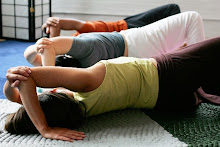
In Awareness Through Movement classes, we usually begin with a sensory "scan" through your body as you lie on the floor. What parts of yourself touch the floor? What parts are lifted away? At first, the sensations cluster together like the patchwork quilt of the Houston power grid. Some places on your body feel very present, "lit up," and detailed. Other places or parts seem more "dim," less distinct. And some places are just "in the dark," where sensation is absent and movement is unimaginable. As you begin to move gently, with attention, your sensations and perceptions gradually change. By the end of the lesson, more of you is "on the grid," present in your mind's eye, lights on, someone home.
We all have that "inner light," the light that we're supposed to let shine. Attention and awareness can bring light, lightness, enlightenment. . . Here's to LIGHTS ON!